Skip to Content

Generative Text

5 posts

Posts tagged with Generative Text

AI Faulty Detector: The Unsettling Reality of Misidentification

Can AI detectors reliably distinguish between human-written and AI-generated content? Uncover the unsettling truth about the accuracy of AI detection tools in the wake of startling insights revealed by AI specialist, Janelle Shane.

AI Faulty Detector: The Unsettling Reality of Misidentification

TL;DR

  • AI detection tools are frequently failing to correctly identify AI-generated content, mistaking it for human-written, and disproportionately flagging content written by non-native English speakers.
  • Janelle Shane, a leading authority on AI, underscores the profound implications of these biases, warning against using AI detectors in crucial decision-making contexts.

Introduction

Janelle Shane, a scientist with a doctorate in engineering, has been a thought leader in the AI field for almost a decade. Recently, her blog, AI Weirdness, touched on a significant issue: the unreliability of AI detection tools and their unintended biases.

Key Facts

  • A study from Stanford University reveals
AI Faulty Detector: The Unsettling Reality of Misidentification Read more

Generative AI for Text

Generative AI transforms text into astounding creations like images, videos, 3D models, and more.

Generative AI for Text

Text-to-Text Models and Their Applications

Introduction to Generative AI

In the course "Introduction to Generative AI," Dr. Gwendolyn Stripling, the artificial intelligence technical curriculum developer at Google Cloud, provides an overview of generative AI. Generative AI is a type of artificial intelligence technology that can produce various types of content, including text, imagery, audio, and synthetic data.

Understanding Artificial Intelligence and Machine Learning

To comprehend generative AI, it is essential to understand the broader concepts of artificial intelligence (AI) and machine learning (ML). AI is a branch of computer science that focuses on the creation of intelligent systems capable of

Generative AI for Text Read more

Master Prompt Engineering: LLM Embedding and Fine-tuning Featured Post

In this lesson, we cover fine-tuning for structured output & semantic embeddings for knowledge retrieval. Unleash AI's full potential! đź§ 

Master Prompt Engineering: LLM Embedding and Fine-tuning

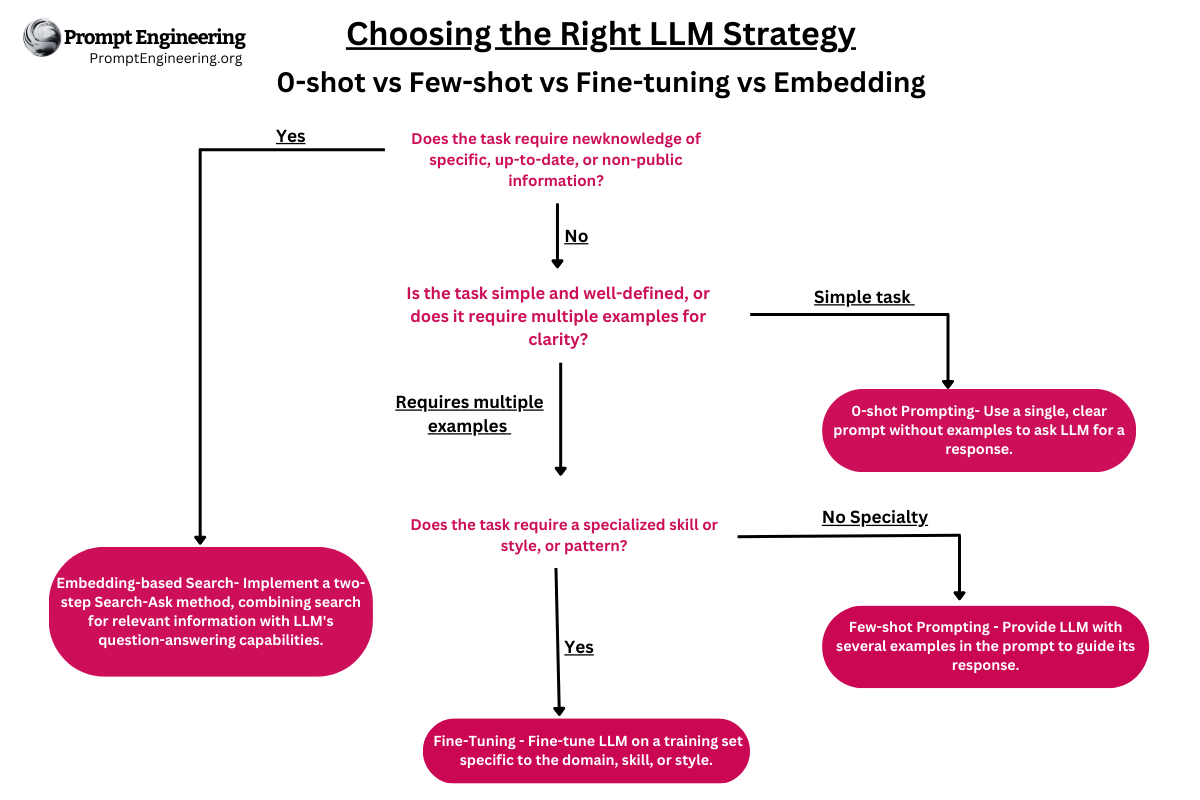
Fine-tuning and embedding LLMs (GPT-3/3.5/4) have become a popular topic of discussion as people seek to leverage the power of this advanced language model for various applications, such as question-answering (QA) and information retrieval.

While both semantic embeddings and fine-tuning are techniques employed to adapt LLMs to specific tasks, they serve different purposes and offer unique benefits.

We will explore these two concepts together as they are related and there is often much confusion about which to use and when.

Core Concepts

LLM Transfer Learning

Transfer learning is a machine learning technique that allows a model to

Master Prompt Engineering: LLM Embedding and Fine-tuning Read more

OpenAI Launches ChatGPT API

OpenAI Launches ChatGPT API

OpenAI, the leader in artificial intelligence and natural language processing, has announced the launch of its latest APIs - ChatGPT and Whisper. These APIs are designed to help developers build powerful apps and products with advanced natural language processing capabilities.

ChatGPT API: Devs New Best Friend in Natural Language Processing

The ChatGPT API is a powerful tool that calls gpt-3.5-turbo, the same model used in OpenAI's ChatGPT product. This model is the best choice for many non-chat use cases, and developers can easily migrate from text-davinci-003 to gpt-3.5-turbo with minimal adjustments needed to their prompts. Expect these to

OpenAI Launches ChatGPT API Read more

Facebook Releases LLaMA: Outperforms ChatGPT

Facebook has released its latest language model, LLaMA, consisting of four foundation models ranging from 7B to 65B parameters. The models outperform GPT-3 175B on most benchmarks

Facebook Releases LLaMA: Outperforms ChatGPT

Today, Facebook has released LLaMA, a set of four foundation models that range in size from 7 billion to 65 billion parameters. These models have been trained on at least 1 trillion tokens, significantly more than what is typically used at this scale, and they have outperformed some of the biggest names in the industry.

Facebook Releases LLaMA: Outperforms ChatGPT Read more