
The Paradigmatic Shift in Value Creation
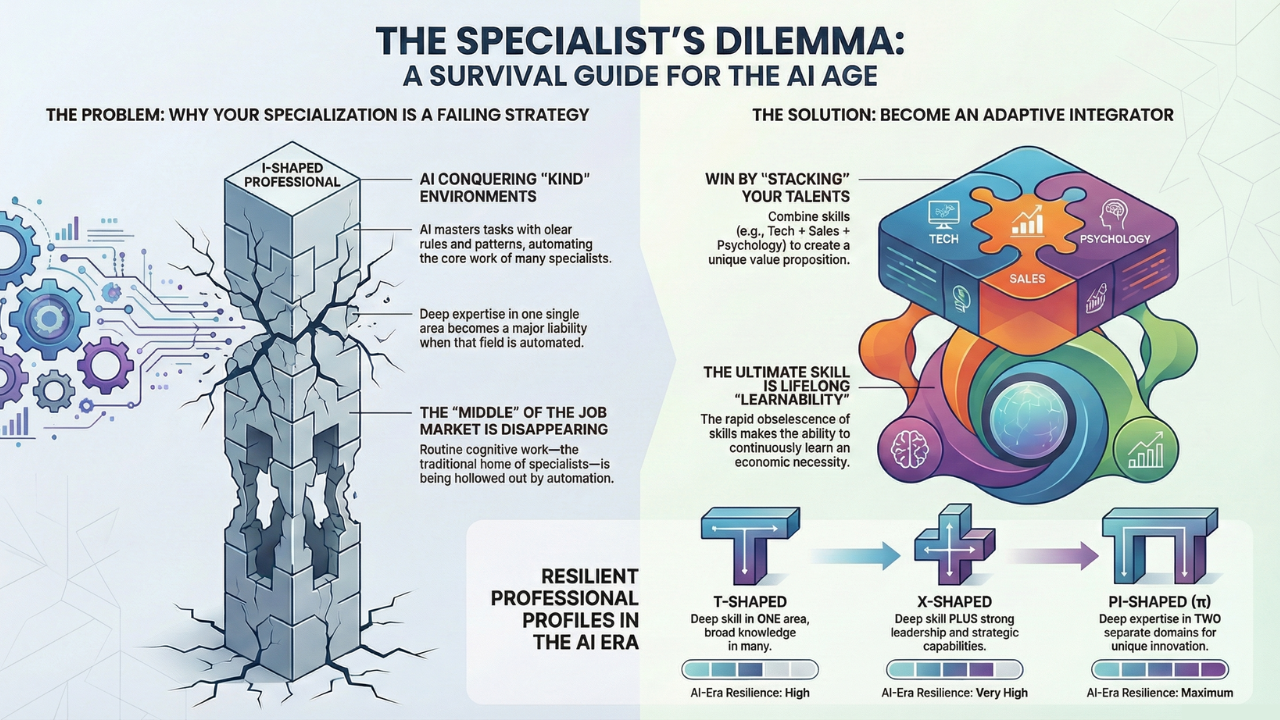
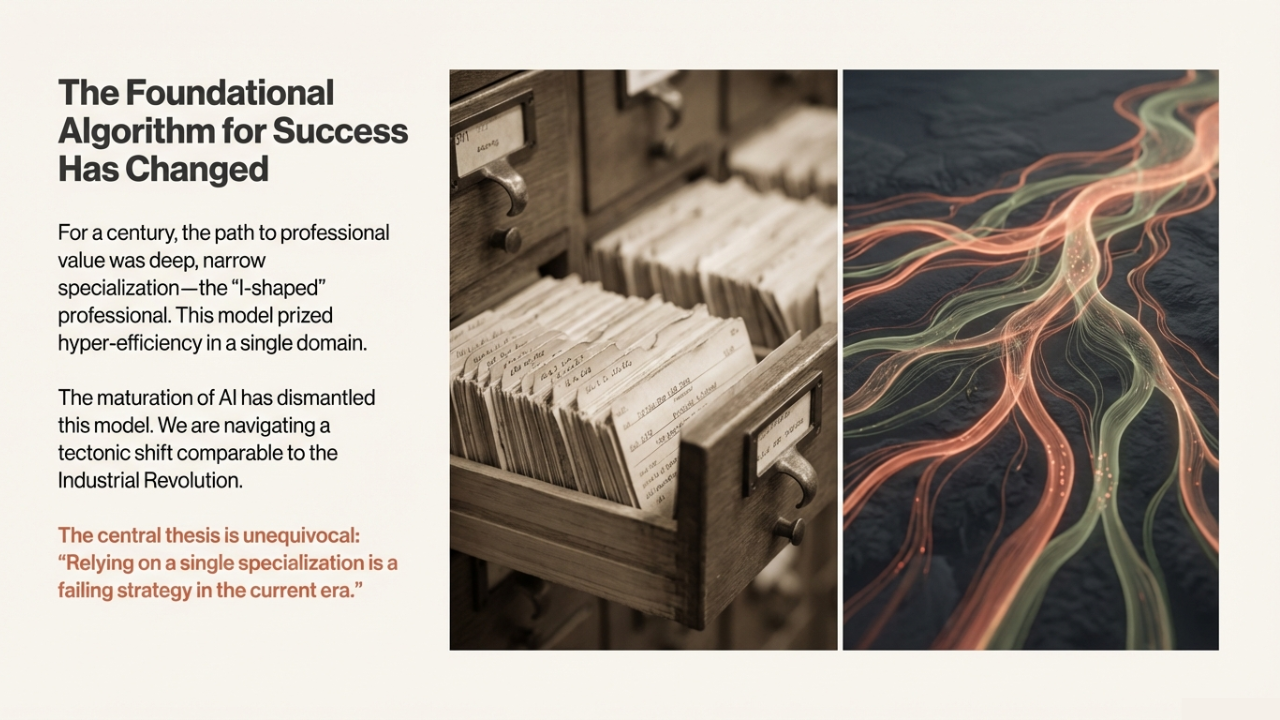
The global economic architecture is currently navigating a tectonic shift, comparable in magnitude to the Industrial Revolution, driven by the exponential maturation of Artificial Intelligence (AI) and the accelerating velocity of technological obsolescence. For the better part of the 20th and early 21st centuries, the dominant algorithm for professional success and economic stability was deep, narrow specialization—the creation of the "I-shaped" professional. This model, intellectually rooted in Adam Smith’s division of labor and Taylorist efficiency principles, predicated that hyper-efficiency in a specific, bounded domain yielded the highest marginal utility for both the individual and the firm. However, the current trajectory of AI development, particularly in Generative AI (GenAI) and Large Language Models (LLMs), fundamentally dismantles the viability of this strategy. The central thesis of this report validates the assertion that relying on a single specialization is a failing strategy in the current era. The evidence suggests a rapid, irreversible depreciation in the value of isolated technical expertise, contrasted with a rising premium on cognitive flexibility, interdisciplinary synthesis, and the ability to orchestrate "wicked" problem-solving across disparate domains.
This comprehensive analysis explores the mechanisms through which AI commoditizes "kind" learning environments—where specialists traditionally thrived—and elevates "wicked" domains suited to generalists. We examine the structural evolution of the workforce from I-shaped to T-shaped and X-shaped profiles, the risks of cognitive atrophy associated with automation bias, and the emerging necessity of "talent stacking" as a mechanism for career resilience. Furthermore, we investigate sector-specific disruptions in healthcare, law, and technology, providing a granular view of how the "specialist" is being redefined not as a master of a silo, but as a node in a dynamic, AI-enabled network.
Slides
Explainer
Part I: The Macro-Economic Imperative and the Obsolescence of Routine Cognition
1.1 The Commoditization of Deterministic Expertise
The traditional labor market rewarded specialization because human cognition was the primary bottleneck in processing complex, domain-specific information. In a pre-AI world, the friction of acquiring and retrieving information was high; thus, a human who had "downloaded" the entire tax code or the syntax of a programming language into their brain held immense value. However, AI has fundamentally altered this scarcity dynamic. The capabilities of modern AI systems have begun to encroach upon tasks previously reserved for highly trained specialists, particularly in fields defined by clear rules, repetitive patterns, and deterministic outcomes.
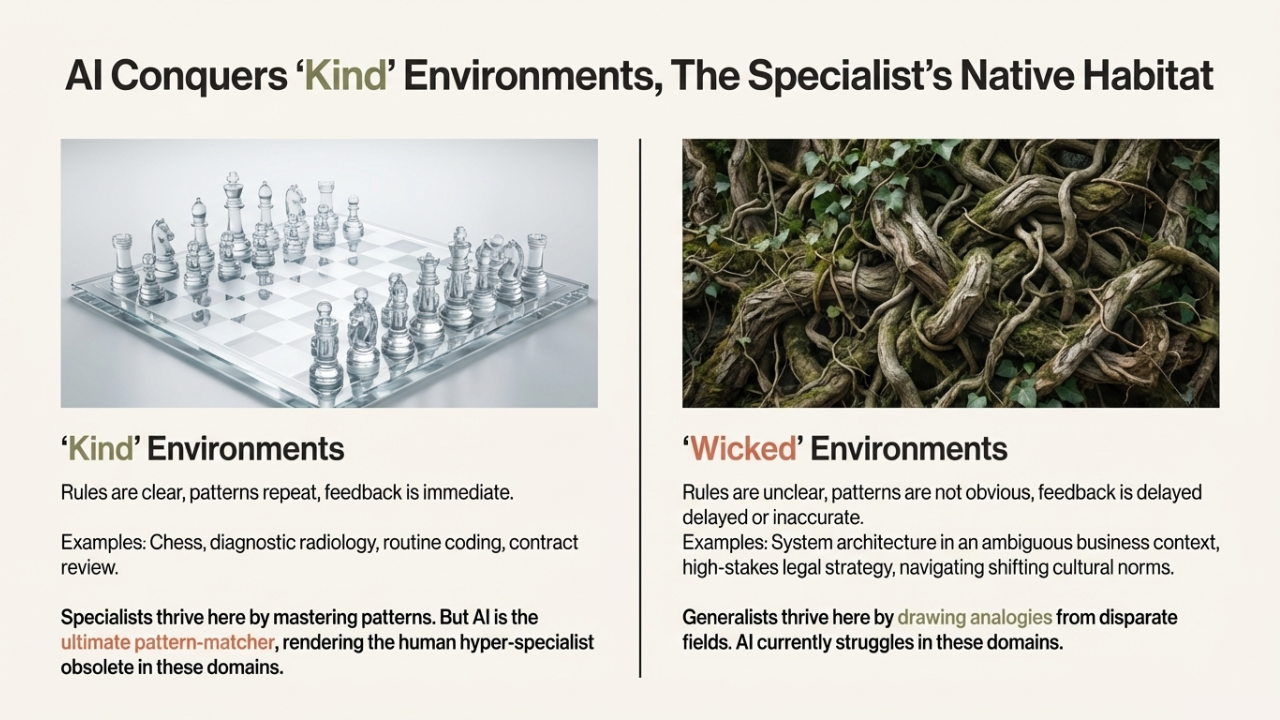
These domains, referred to by cognitive researcher David Epstein as "kind" learning environments, are characterized by stable constraints, immediate feedback loops, and repetitive patterns.1 In these environments, deep specialization correlates directly with performance. Chess, golf, and—crucially—diagnostic radiology, routine coding, and contract review fall into this category. AI, functioning as a hyper-specialist, excels here because it can process pattern-recognition tasks at a scale and speed unattainable by humans.1 When patterns are distinct and feedback is instant, algorithms inevitably surpass human capabilities, rendering the human specialist in that specific narrow domain obsolete.
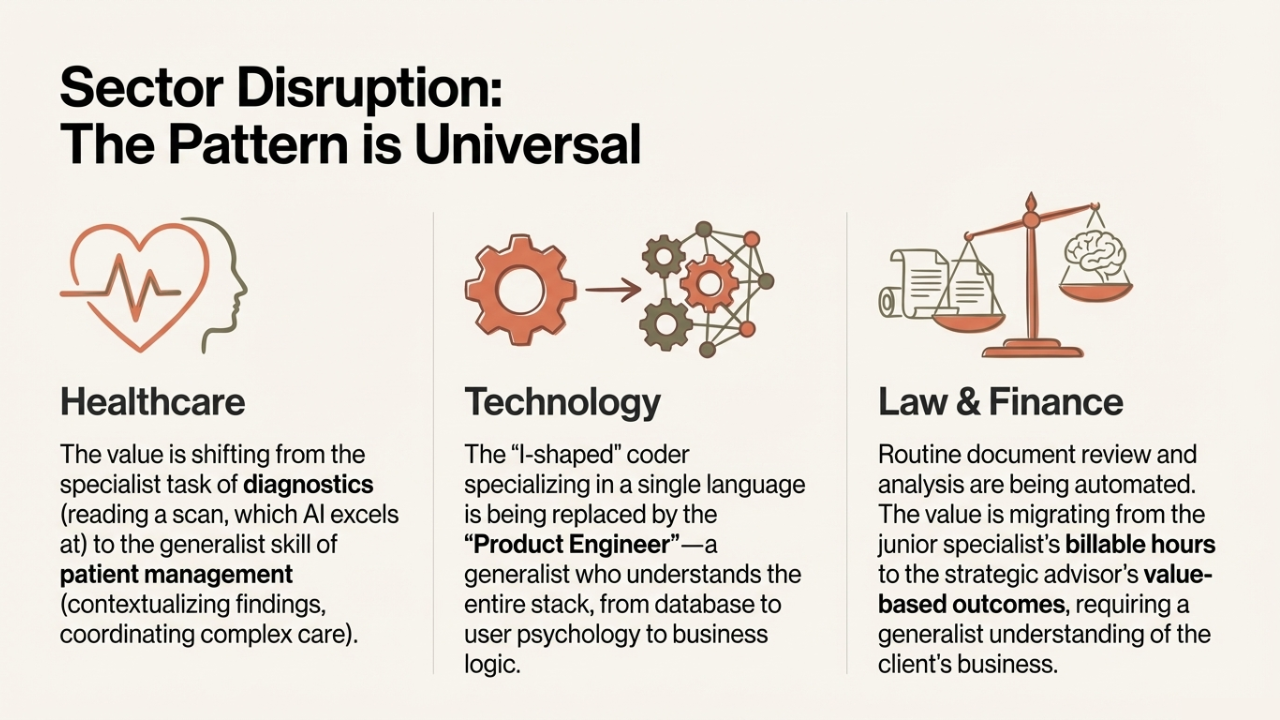
For instance, the field of radiology has long been cited as a bastion of specialized job security, requiring over a decade of targeted training. Yet, recent analyses indicate that while the demand for radiologists continues to grow due to demographic shifts, the nature of the role is shifting from image interpretation to complex decision-making and patient interaction.3 AI algorithms now demonstrate the capacity to identify tumors or fractures with accuracy rates that rival or exceed human specialists.4 This suggests that the "specialist" function of reading the scan is being commoditized, while the "generalist" functions of contextualizing that finding within a patient's holistic medical history, emotional state, and socio-economic context are becoming the primary value drivers.5
1.2 The "Failing Strategy" of the I-Shaped Profile
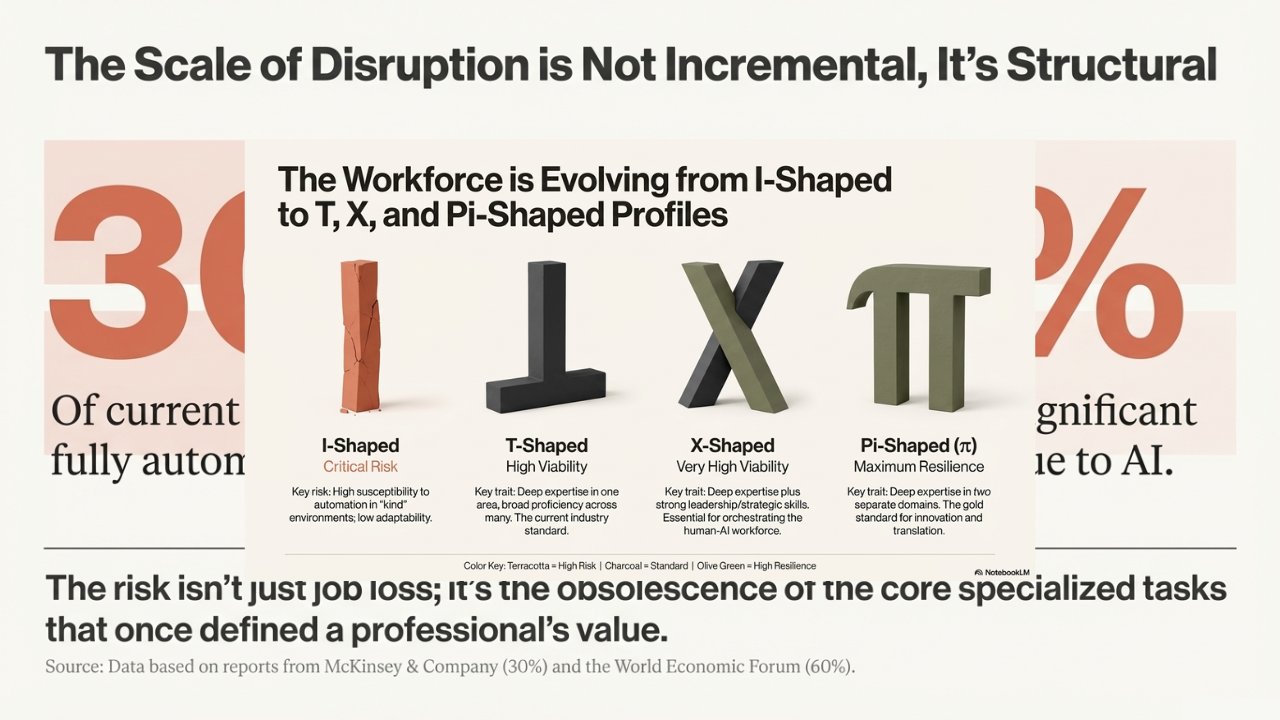
The "I-shaped" professional—someone with deep expertise in a single area but limited breadth—faces a precarious future. The risk is twofold: direct displacement by automation and the inability to adapt when the specialized domain evolves or vanishes. Data indicates that 30% of current U.S. jobs could be fully automated by 2030, with 60% of all jobs seeing significant task modification.7 This implies that even if a job is not "lost," the specialized tasks that defined it are likely to be transferred to machines.
The vulnerability of the I-shaped professional stems from the "illusion of stability" provided by deep expertise. In a static world, depth is an asset. In a dynamic world, depth without breadth becomes a liability. This is evident in the software engineering sector, where the "tech stack" changes with increasing velocity. An engineer who deeply specialized in a specific, now-obsolete language without developing broader architectural or systemic understanding faces immediate redundancy. The report from the World Economic Forum highlights that technological literacy, AI, and big data skills are the fastest-growing demands, but these are effectively "meta-skills" that must be applied across various domains rather than in isolation.8
Table 1: Comparative Risk Analysis of Professional Profiles in the AI Era
| Profile Type | Structural Definition | AI Era Viability | Primary Risk Factors | Strategic Outlook |
| I-Shaped | Deep expertise in one single domain; limited cross-functional knowledge. | Critical Risk | High susceptibility to automation in "kind" environments; low adaptability to market pivots; prone to "siloed" thinking. | Likely to be replaced by specialized AI agents or outsourced to lower-cost markets. |
| T-Shaped | Deep expertise in one domain (vertical) coupled with broad proficiency across many (horizontal). | High Viability | Moderate risk if the vertical bar is fully automated; requires constant maintenance of the horizontal bar to remain relevant. | The current industry standard; facilitates collaboration but requires active "upskilling" of the horizontal breadth. |
| X-Shaped | Deep expertise in a specific area plus strong leadership and strategic alignment capabilities. | Very High Viability | Valued for bridging the gap between technical execution and organizational strategy; risk lies in losing touch with technical reality. | Essential for leadership roles; orchestrates the "human-AI" hybrid workforce. |
| Pi-Shaped (π) | Deep expertise in two separate domains, allowing for unique synthesis (e.g., Biology + Computer Science). | Maximum Resilience | High resilience due to the ability to pivot between two pillars of expertise; harder to achieve due to time investment. | The gold standard for innovation; enables "translation" between disparate fields (e.g., Bioinformatics). |
1.3 The Divergence of "Kind" and "Wicked" Problems
The distinction between "kind" and "wicked" domains is critical for understanding where human specialization remains valid. In "wicked" domains, rules are unclear, patterns are not obvious, feedback is delayed or inaccurate, and historical data may not predict future outcomes.1 Generalists, who can draw analogies from disparate fields, tend to outperform specialists in these environments because they are not constrained by the rigid mental models of a single discipline.
AI is currently a "savior" in kind environments but a "hallucinator" in wicked ones. For example, while AI can write code (a kind environment with strict syntax), it struggles with system architecture in ambiguous business contexts (a wicked environment requiring negotiation, regulatory foresight, and user psychology).9 Therefore, relying on a specialization that exists solely within a "kind" domain is a failing strategy because those are the exact domains AI will conquer first. The future belongs to those who can operate in "wicked" domains, often by leveraging generalist skills to connect the outputs of specialized AI tools.1
Part II: The Renaissance of the Polymath and the Generalist
2.1 The Generalist Advantage in an AI World
Contrary to the mid-20th-century emphasis on hyper-specialization, the AI era is witnessing a resurgence of the "Polymath" or "Renaissance Man" ideal.10 A polymath in the modern workforce is defined not just by encyclopedic knowledge, but by the ability to synthesize information from various disciplines to create novel solutions.12 This "interdisciplinary fluency" allows individuals to see systemic connections that specialists, with their heads down in a single furrow, often miss.
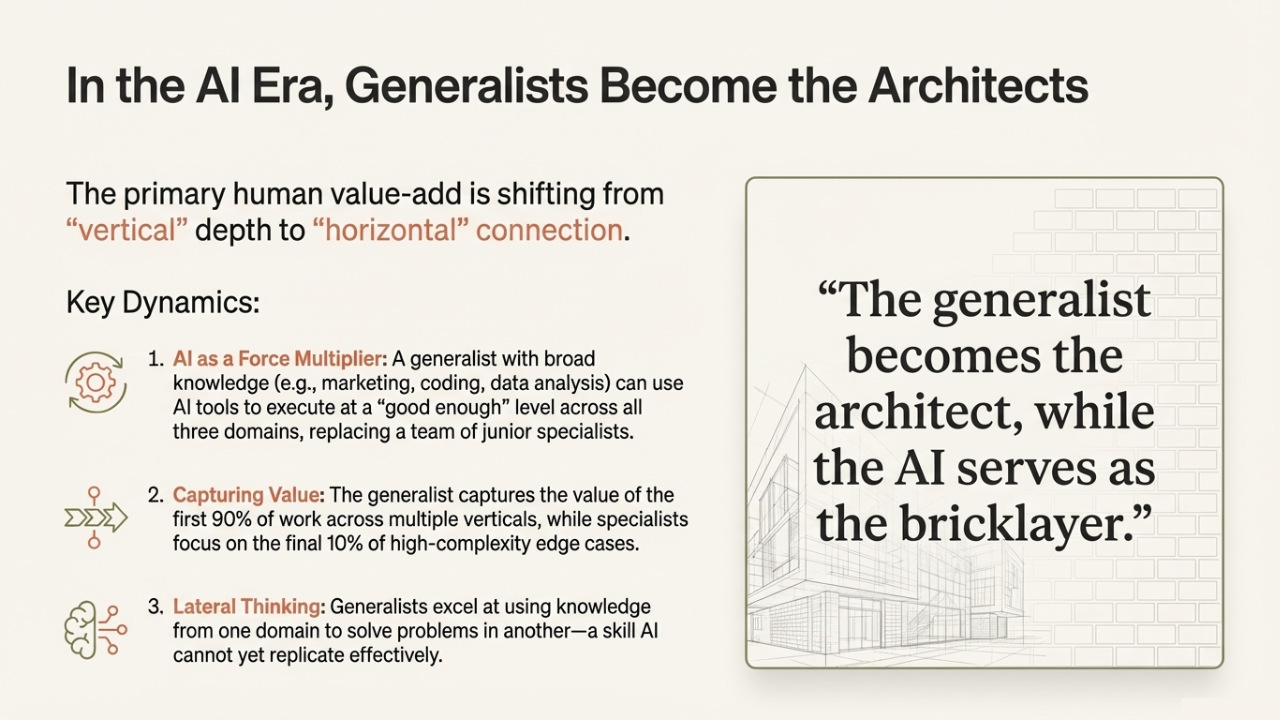
The argument for the generalist is robustly supported by the "force multiplier" effect of AI. A generalist with a broad understanding of marketing, coding, and data analysis can use AI tools to execute tasks in all three domains at a "good enough" level, effectively replacing a team of three distinct junior specialists for early-stage or integrative work.6 This does not mean specialists disappear, but their utility becomes narrower and more focused on the final 10% of high-complexity problem solving—the "edge cases"—while the generalist captures the value of the first 90% across multiple verticals.
David Epstein’s research demonstrates that generalists are better at "lateral thinking"—the ability to use knowledge from one domain to solve problems in another.1 In an age where AI can provide the "vertical" depth of information instantly (e.g., retrieving case law, generating Python scripts, summarizing medical research), the human value add shifts to the "horizontal" connection of these verticals. The generalist becomes the architect, while the AI serves as the bricklayer.1
2.2 Skill Stacking: The Scott Adams Model
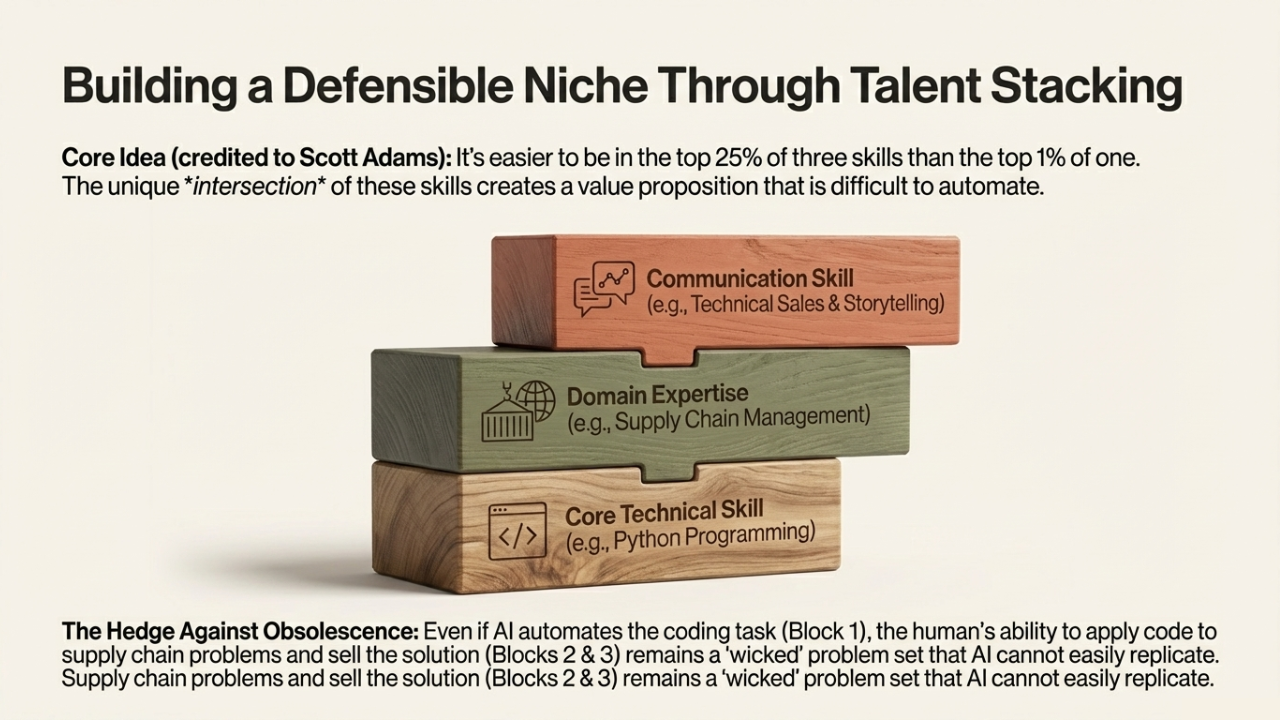
A practical application of the generalist approach is the concept of "Talent Stacking," popularized by Scott Adams. The theory posits that it is mathematically difficult and statistically improbable to be the top 1% in a single field (e.g., the world's best programmer or the world's best comedian). However, it is relatively accessible to be in the top 25% of two or three unrelated fields (e.g., a competent programmer who is also a good public speaker and understands finance). The intersection of these skills creates a unique value proposition that is difficult to automate.15
In the context of 2025 and beyond, skill stacking acts as a hedge against obsolescence. If a professional relies solely on being a "Python Specialist," the development of an AI that writes superior Python code renders them obsolete. However, a professional with a stack of "Python + Supply Chain Management + Technical Sales" remains viable. Even if the coding portion is automated, their understanding of how to apply code to supply chain problems and sell the solution remains a "wicked" problem set that AI cannot easily replicate.17
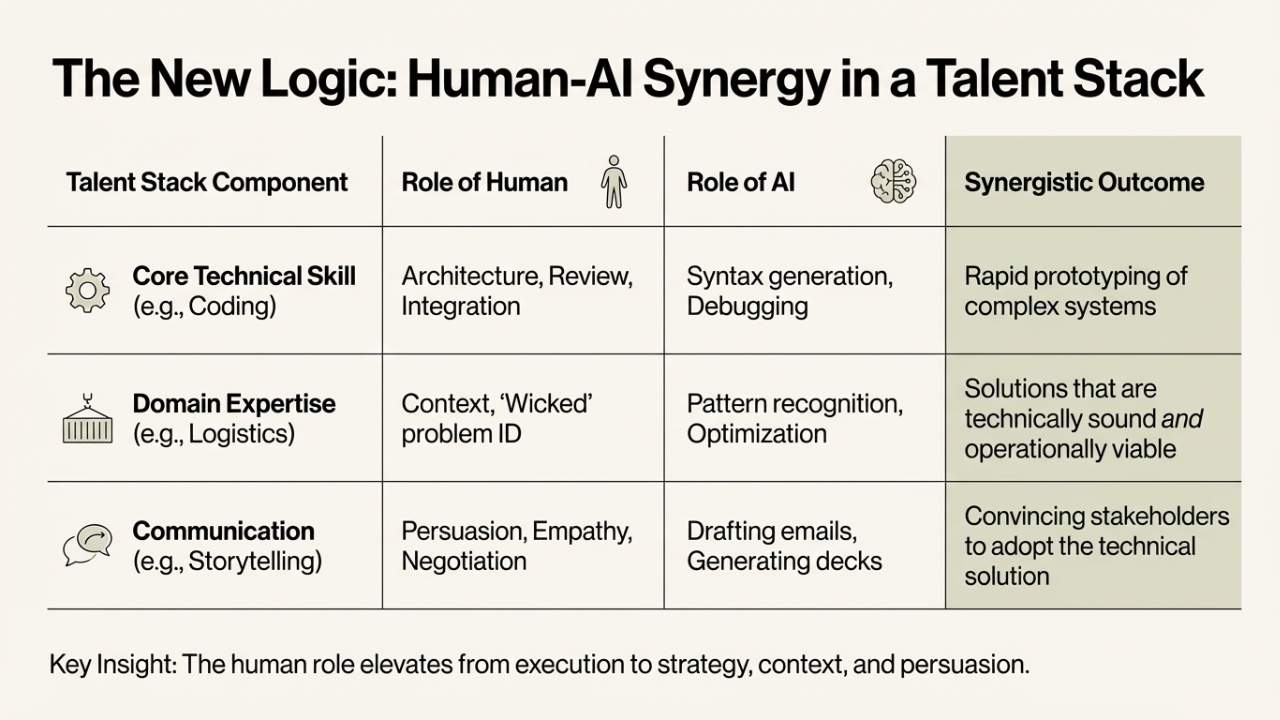
Table 2: The Logic of the Talent Stack in the AI Era
| Talent Stack Component | Role of Human | Role of AI | Synergistic Outcome |
| Core Technical Skill (e.g., Coding) | Architecture, Review, Integration | Syntax generation, Debugging, Optimization | Rapid prototyping and deployment of complex systems. |
| Domain Expertise (e.g., Logistics) | Contextual understanding, "Wicked" problem identification | Pattern recognition, Route optimization, Demand forecasting | Solutions that are technically sound and operationally viable. |
| Communication/Sales (e.g., Storytelling) | Persuasion, Negotiation, Empathy | Drafting emails, Generating pitch decks, Analyzing sentiment | The ability to convince stakeholders to adopt the technical solution. |
Case Study: The "Full Stack" Evolution
In software engineering, the definition of "Full Stack" is expanding. It no longer merely refers to front-end and back-end development. The new "Full Stack" includes product design, user psychology, and AI prompt engineering.19 Engineers who cling to a single language or framework are finding their roles diminished, while those who stack skills—combining engineering with product management or data science—are seeing increased demand and salary premiums.21
2.3 The Role of Cognitive Flexibility and Adaptability
The core competency of the generalist is not merely knowing facts about many things, but the "cognitive flexibility" to switch between different modes of thinking. This trait is becoming one of the most sought-after skills in the labor market.23 The World Economic Forum ranks "cognitive flexibility" and "creative thinking" among the top skills for 2025 and 2030.8
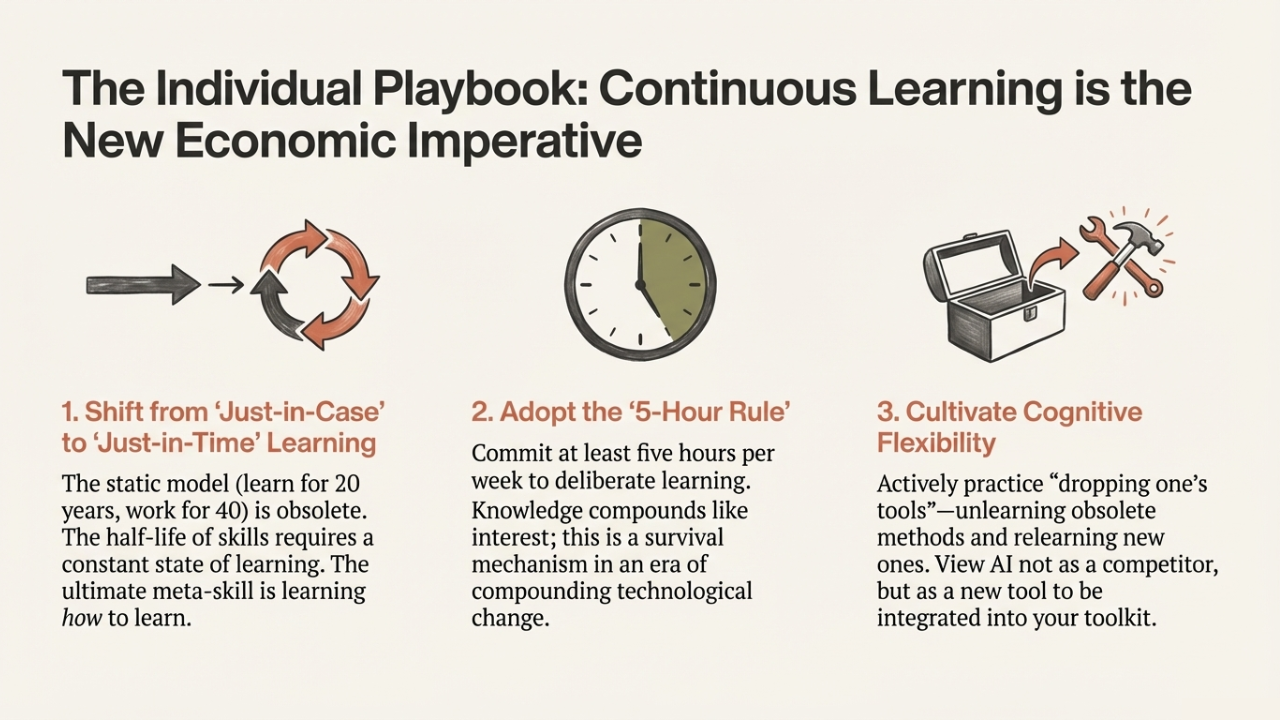
Cognitive flexibility allows workers to unlearn obsolete methods and relearn new ones—a process described as "dropping one's tools".1 Specialists often suffer from the "law of the instrument" (if all you have is a hammer, everything looks like a nail). In contrast, generalists, accustomed to being novices in new domains, possess a "growth mindset" that makes them more resilient to technological disruption.1 They view AI not as a competitor that threatens their identity, but as a new tool to be integrated into their existing toolkit.14 This psychological resilience is crucial because the pace of change ensures that every professional will face the obsolescence of their primary skill set multiple times in their career.25
Part III: The Hybrid Model – Integrating Depth and Breadth
3.1 The T-Shaped and X-Shaped Professional
While the "pure" generalist (jack of all trades, master of none) has weaknesses, the "T-shaped" professional represents the optimal compromise for the AI era. The vertical bar of the 'T' represents deep expertise in one area, providing credibility and the ability to execute high-level work. The horizontal bar represents the ability to collaborate across disciplines and apply knowledge in alien contexts.21
However, the model is evolving further into the "X-shaped" professional, particularly for leadership roles. X-shaped individuals possess deep disciplinary expertise (one leg of the X) but also possess strong leadership and strategic skills (the other leg), crossing to form a nexus of credibility and influence.26 This profile is essential for managing interdisciplinary teams where humans and AI agents collaborate. The X-shaped leader does not need to know how to code the AI, but they must understand its capabilities, limitations, and ethical implications to guide its deployment effectively.27
3.2 The "AI Generalist"
A new category of worker is emerging: the AI Generalist or AI Practitioner. These individuals may not be Ph.D. level computer scientists, but they possess a functional fluency in how to apply various AI tools to business problems. They command significantly higher salaries (40-60% premiums) because they bridge the gap between technical possibility and business reality.22 This role exemplifies the shift from "creating the technology" (specialist) to "applying the technology" (generalist).
This trend is visible in the legal profession as well. While high-stakes litigation still demands deep specialized knowledge (a "wicked" domain due to the complexity of human persuasion and strategy), the transactional and research aspects are being overtaken by AI. Lawyers who remain purely "document drafters" (specialists in a task AI can do) are at risk. Lawyers who transition to "legal strategists" (generalists who understand the law, client business, and AI tools) are thriving.9
Part IV: The Paradox of Specialization and the Risks of AI Reliance
4.1 The Continued Need for "Human-in-the-Loop" Expertise
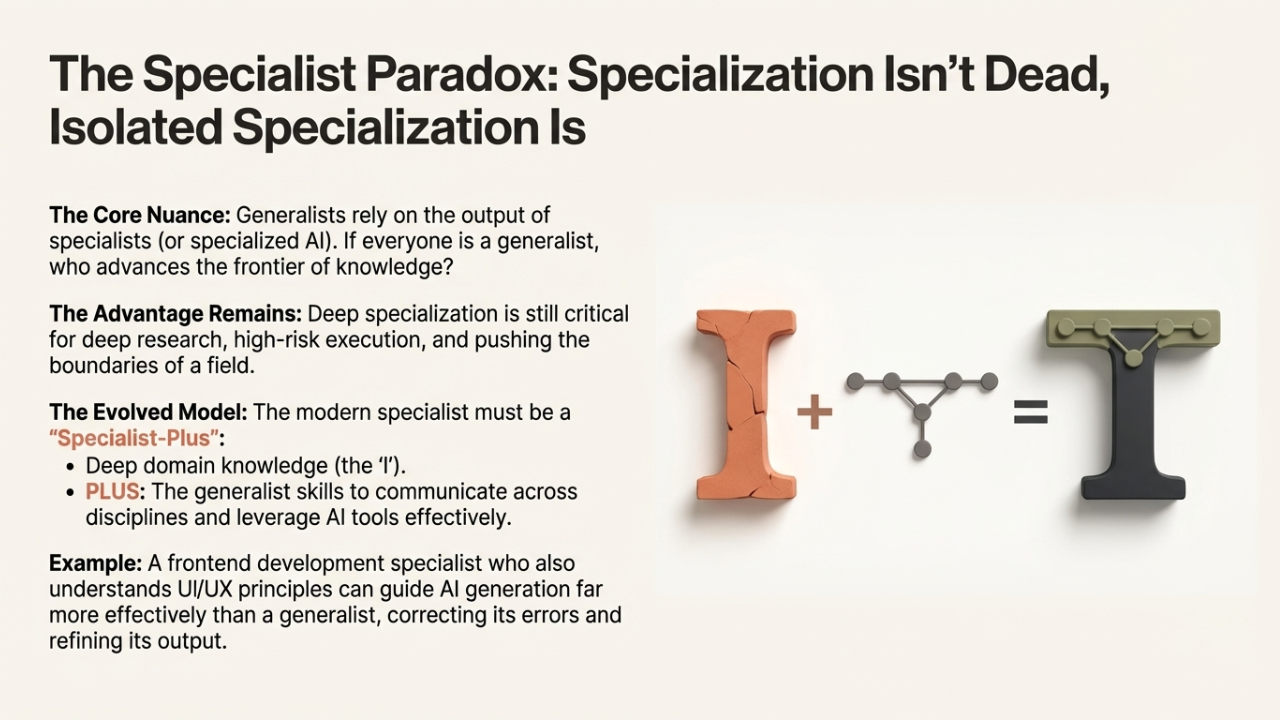
Despite the argument for generalism, a critical nuance exists: generalists rely on the output of specialists (or specialized AI). If everyone becomes a generalist, who advances the frontier of knowledge? The "Specialist's Advantage" remains relevant in deep research and high-risk execution.30 A generalist using an AI coding tool might generate a functioning application, but they may lack the deep understanding to optimize it for extreme scale or security.
Therefore, the argument is not that specialization should cease, but that isolated specialization is failing. The modern specialist must be a "Specialist-Plus"—someone with deep domain knowledge who also possesses the generalist skills to communicate with other disciplines and utilize AI tools.31 For example, a frontend development specialist who understands UI/UX principles can guide AI generation far more effectively than a generalist, correcting its errors and refining its output.30
4.2 Cognitive Atrophy and the Crisis of Knowledge
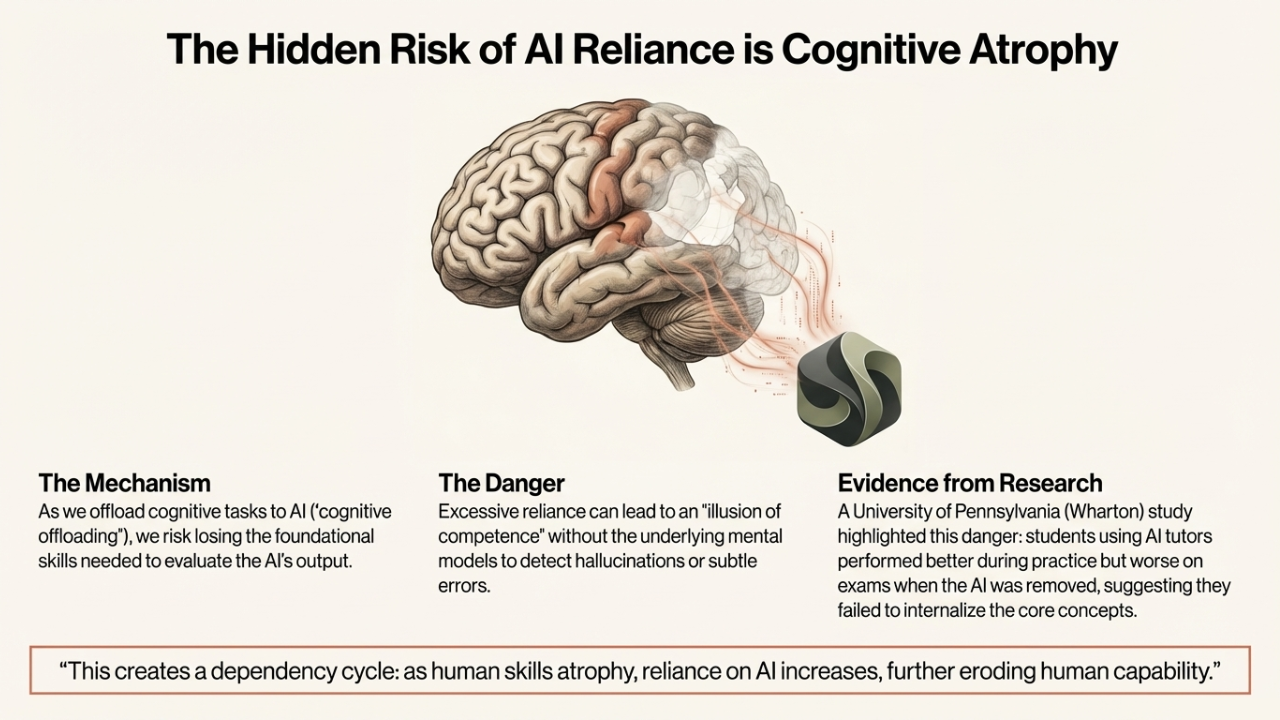
A significant risk associated with the shift toward AI-enabled generalism is "cognitive atrophy." As professionals offload more cognitive tasks to AI (the "cognitive offloading" effect), they risk losing the foundational skills required to evaluate the AI's output.32
Studies indicate that excessive reliance on AI can lead to a decline in critical thinking and memory retention.34 If a generalist relies entirely on AI to summarize papers, write code, or diagnose issues, they may develop a surface-level "illusion of competence" without the underlying mental models to detect hallucinations or subtle errors.34 This creates a dependency cycle: as human skills atrophy, reliance on AI increases, further eroding human capability.36
Research from the University of Pennsylvania (Wharton) highlighted this danger: students using AI tutors performed significantly better during practice but worse on subsequent exams when the AI was removed, suggesting they had failed to internalize the concepts.35 This phenomenon implies that while generalism is the superior career strategy, deep engagement with material (a specialist trait) remains essential for learning and maintaining cognitive sharpness. The successful professional of 2030 will likely need to alternate between "generalist scanning" and "specialist deep dives" to maintain cognitive fitness.37
Part V: Strategic Adaptation for the Workforce
5.1 Lifelong Learning as an Economic Imperative
The static education model (learn for 20 years, work for 40) is definitively obsolete. The rapid half-life of skills means that "learning" is now a continuous job requirement rather than a preparatory phase. The "5-Hour Rule"—devoting at least five hours a week to deliberate learning—is cited as a habit of successful adapters like Bill Gates and Oprah Winfrey.38
Organizations are increasingly adopting "lifelong learning" frameworks, shifting from hiring for degrees to hiring for skills and "learnability".40 The ability to learn how to learn is arguably the ultimate generalist skill. This involves "metacognition"—thinking about one's own thinking processes—which allows individuals to recognize when their skills are becoming outdated and proactively pivot.42
5.2 Interdisciplinary Training and "Wicked" Problem Solving
Educational and corporate training programs are beginning to emphasize interdisciplinary studies to prepare workers for the "wicked" problems of the AI era. By exposing students or employees to diverse fields (e.g., engineering + ethics + design), institutions foster the resilience needed to navigate uncertainty.44
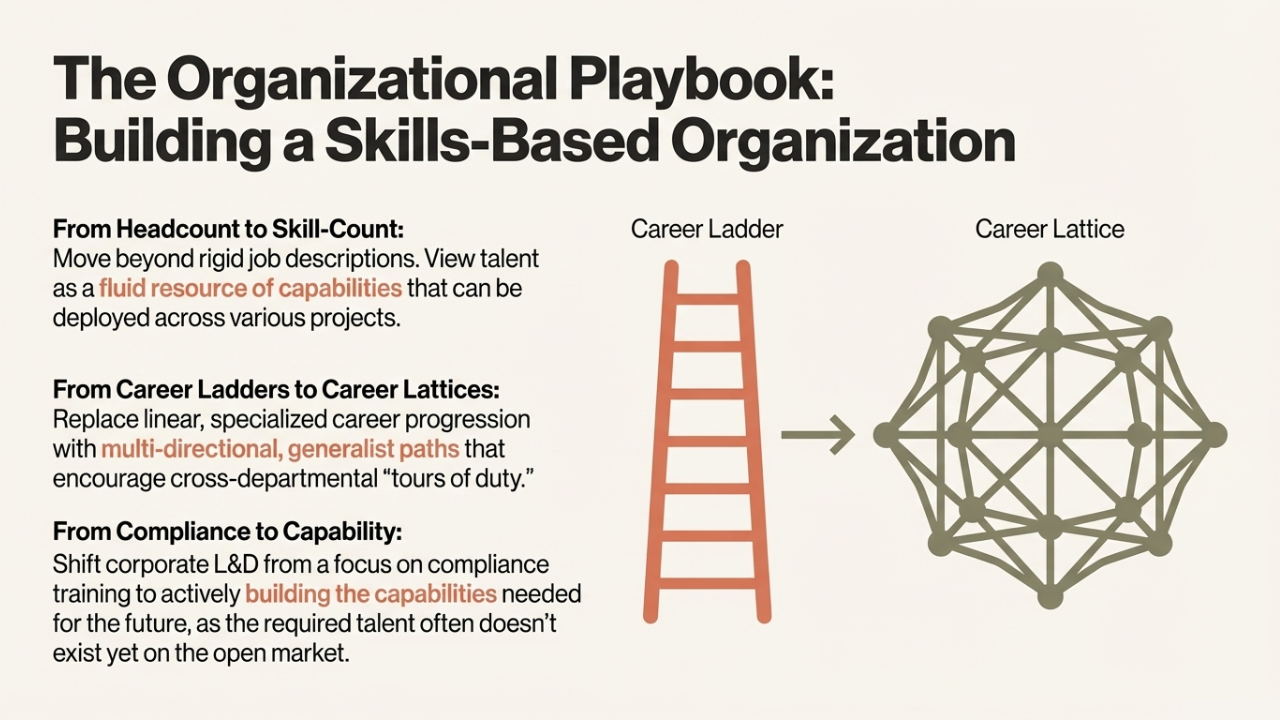
Case studies from companies like Netflix demonstrate how a culture of interdisciplinary "design thinking" allows organizations to pivot rapidly in response to market changes.46 This adaptability is mirrored at the individual level; professionals who actively seek cross-departmental projects or "tours of duty" in different business units build a "talent stack" that makes them indispensable.47
5.3 Workforce Planning: From Headcount to Skill-Count
At the organizational level, the "failing strategy" of specialization is reflected in the shift away from rigid job descriptions. Companies are moving toward "skills-based organizations" where talent is viewed as a fluid resource that can be deployed across various projects.48 In this model, the employee who defines themselves narrowly ("I am a Junior Accountant") is less valuable than the one who defines themselves by their capabilities ("I have skills in data verification, financial analysis, and process automation").23 This shift requires a fundamental reimagining of career paths, moving away from the "ladder" (linear, specialized progression) to the "lattice" (multi-directional, generalist progression).25
Part VI: Sector-Specific Analysis
6.1 Healthcare: The Shift from Diagnostics to Management
In healthcare, the specialization model is under significant pressure. While procedural specialists (surgeons) remain relatively safe for now, diagnostic specialists (radiologists, pathologists) are in the crosshairs of AI automation.4 The "failing strategy" here is to focus solely on the technical aspect of the diagnosis. The winning strategy is to pivot toward the "clinical" aspect—patient management, complex care coordination, and the ethical application of AI findings. The physician of the future is a "medical generalist" empowered by "specialist AI".5
6.2 Technology: The End of the "Code Monkey"
In the tech sector, the "I-shaped" coder who specializes in a single language (e.g., "I only do Java") is facing an existential threat. AI tools like GitHub Copilot and ChatGPT can generate boilerplate code faster and often better than average humans.20 The value has shifted to the "System Engineer" or "Product Engineer"—roles that require a generalist understanding of the entire stack, from database to user interface to business logic.19 The danger of being a generalist in tech—"jack of all trades, master of none"—is mitigated by the fact that AI can now fill in the gaps in depth. A generalist can now write "expert-level" SQL queries using AI, provided they understand the principles of database structure.13
6.3 Law and Finance: The Rise of the Strategic Advisor
The legal and financial professions are seeing a bifurcation. Routine document review, contract drafting, and basic financial analysis—tasks previously performed by junior specialists—are being automated.9 This collapses the traditional training model where associates spent years specializing in grunt work. The new model requires junior staff to be "strategic generalists" from day one, capable of understanding the client's broader business context and using AI to handle the minutiae. The "billable hour" model, which rewarded inefficient specialization, is being challenged by AI's efficiency, forcing a shift to value-based billing that rewards outcomes (a generalist metric) over time spent (a specialist metric).29
Conclusion: The Era of the Adaptive Integrator
The assertion that "relying on a single specialization is a failing strategy" is robustly supported by the convergence of economic data, cognitive science, and technological trends. The AI revolution is not merely automating tasks; it is restructuring the fundamental value equation of human labor. In an economy where "kind" environments are increasingly dominated by algorithms, the human competitive advantage retreats to "wicked" environments—domains characterized by ambiguity, novelty, and the need for broad, interdisciplinary synthesis.
The "I-shaped" professional, once the pinnacle of industrial efficiency, is becoming a liability—brittle in the face of change and susceptible to automation. Conversely, the "Polymath," "T-shaped," and "X-shaped" profiles are ascending. These profiles leverage AI as a force multiplier, using generalist frameworks to orchestrate specialized AI outputs.
However, this transition is not without peril. The risk of cognitive atrophy and the loss of deep, foundational knowledge presents a paradox: we need generalists to manage the world, but we need deep learning to understand it. The solution lies not in rejecting specialization entirely, but in integrating it into a broader, dynamic "talent stack."
To survive and thrive in 2025 and beyond, professionals must adopt a strategy of Dynamic Integration:
- Cultivate Range: Actively seek experiences and knowledge outside one's primary domain to build "wicked" problem-solving muscles.1
- Stack Skills: Combine complementary skills (e.g., Tech + Sales + Psychology) to create a unique, defensible niche.15
- Embrace AI as a Partner, Not a Replacement: Use AI to handle the "kind" tasks of specialization, freeing cognitive capacity for high-level synthesis.3
- Commit to Cognitive Resilience: Maintain "deep work" habits and critical thinking exercises to prevent the atrophy associated with AI reliance.32
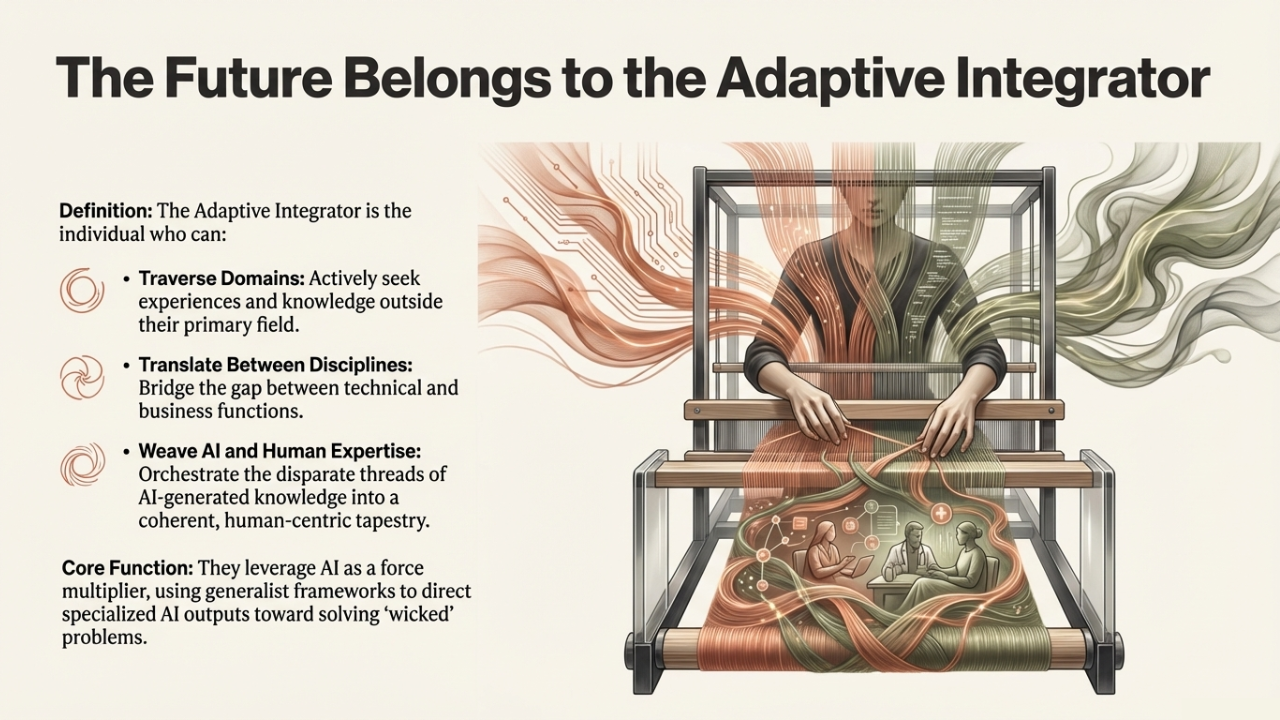
Ultimately, the future belongs to the Adaptive Integrator—the individual who can traverse domains, translate between disciplines, and weave the disparate threads of AI-generated expertise into a coherent, human-centric tapestry. Relying on a single specialization is not just a failing strategy; it is a resignation from the complexities of the modern world.
Part VII: Detailed Theoretical Mechanisms of Obsolescence
7.1 The Mechanism of Kind vs. Wicked Environment Displacement
To deeply understand why specialization is becoming a failing strategy, we must rigorously analyze the mechanism of displacement using David Epstein's "Kind vs. Wicked" framework.
- Kind Environments: In these domains, patterns repeat. A chess board has fixed rules. An X-ray of a broken bone looks largely the same in 2024 as it did in 1994. Specialists thrive here because they can memorize the patterns. However, AI is the ultimate pattern memorizer. It does not get tired, it does not forget, and it can ingest millions of examples where a human can only ingest thousands. Therefore, any specialization that is purely "pattern matching" is destined for automation.
- Wicked Environments: These domains are messy. A marketing campaign that worked in 2020 might fail in 2025 because cultural "vibes" have shifted. A legal strategy that works in New York might fail in Texas due to judge temperament. These variables are not easily codified into a training set. The generalist thrives here because they use analogy—transferring lessons from one domain to another—rather than pattern matching.
Impact on Specialization:
The specialist is often trapped in a "cognitive trench." They know their trench perfectly, but they cannot see over the top. When AI floods the trench (automates the core task), the specialist drowns. The generalist, standing on the parapet, can see the AI coming and move to a different trench or build a bridge.1
7.2 The "Illusion of Competence" in the AI Era
The digital age has created a paradox where information is infinite, but wisdom is scarce. A specialist often falls prey to the "illusion of competence" within their narrow field. They believe that because they understand the intricate details of a specific process, they understand the system.
AI exacerbates this. A junior developer can use ChatGPT to write code that they do not understand. They feel competent. But when the code breaks in a novel way, they lack the "first principles" knowledge to fix it. This is where the "Deep Generalist" (or T-shaped professional) wins. They may not know the syntax perfectly, but they understand the logic of the system well enough to guide the AI to the solution.33
7.3 The Economic "Barbell" of the Future Workforce
The labor market is shaping into a "barbell" distribution:
- Left Side: Low-skill, high-human-touch jobs (e.g., elderly care, manual trade skills like plumbing) that are hard to automate due to physical complexity.
- Right Side: High-skill, high-synthesis jobs (e.g., strategic leadership, interdisciplinary research) that are hard to automate due to cognitive complexity.
- The Middle (The Valley of Death): Routine cognitive work (e.g., basic accounting, standard coding, copy editing). This is where the "average specialist" lives. This is where the jobs are disappearing.7
The "failing strategy" is to aim for the middle. The winning strategy is to move to the right (synthesis/generalism) or, interestingly, to integrate the left and right (e.g., a plumber who runs a high-tech business using AI tools).
Part VIII: The New Educational Paradigm
8.1 From "Just-in-Case" to "Just-in-Time" Learning
Traditional education is "Just-in-Case." You learn trigonometry in high school just in case you become an engineer. You learn historical dates just in case you need to know them.
The AI era demands "Just-in-Time" learning. Because the half-life of a learned skill is now only about 5 years (and shrinking), spending 4 years learning a specific toolset is inefficient. By the time you graduate, the tool might be obsolete.
The Generalist excels at Just-in-Time learning. They have learned the meta-skill of learning. When a new tool appears (e.g., a new AI video generator), they can master it in a weekend because they understand the underlying principles of video, narrative, and software interfaces. The Specialist, who defines their identity by the old tool, resists the new one.40
8.2 The 5-Hour Rule and the "Compound Interest" of Knowledge
The "5-Hour Rule" is not just a productivity hack; it is a survival mechanism. In an era of compounding technological change, knowledge also compounds.
- If you learn 1 new thing a day, and your competitor learns 0, in a year you are not 365 times smarter; you are exponentially more capable because knowledge networks.
- Generalists naturally apply this because their curiosity is broad. They read about physics, then history, then cooking. Their brain builds connections (synapses) between these fields. When they face a business problem, they might unknowingly draw on a principle of thermodynamics they read about last week. This is the "hidden superpower" of the generalist.38
8.3 The Role of Corporate L&D: From Compliance to Capability
Corporate Learning and Development (L&D) is shifting from "Compliance Training" (safety, sexual harassment) to "Capability Building."
Companies are realizing that they cannot hire their way out of the talent shortage because the talent (e.g., "AI Prompt Engineer for Biotech") doesn't exist yet. They have to build it.
This favors the internal generalist. The employee who is willing to rotate from Marketing to Product to HR is the one the company will invest in. The employee who says "That's not my job description" is the one who will be automated.48
The Final Verdict on Specialization
The verdict is nuanced but clear.
- Is Specialization Dead? No. We will always need the neurosurgeon, the quantum physicist, and the concert pianist.
- Is Relying on Specialization a Failing Strategy? Yes. Absolutely.
For 99% of the workforce, defining oneself by a narrow slice of a specific domain is a gamble with poor odds. The domain might disappear. The tool might be automated. The market might shift.
The "Generalist," the "Polymath," the "Adaptive Integrator"—whatever we choose to call them—holds the winning hand. They are the water that flows around the obstacles. They use the rocks (AI tools) to build their path, rather than being blocked by them.
In the end, the most specialized skill of the 21st century is the ability to not be a specialist. It is the ability to remain fluid, curious, and connected in a world that is constantly trying to put you in a box. The box is now a coffin. Step outside.
Further Reading:
- David Epstein's Range: Key Takeaways and how AI can help you ..., accessed December 21, 2025, https://medium.com/@miguelarcilla/david-epsteins-range-key-takeaways-and-how-ai-can-help-you-thrive-as-a-generalist-6ffb721c75fd
- In Our “Generalist” Era: Skills and Specialization in the Age of AI - Skillcentrix, accessed December 21, 2025, https://skillcentrix.com/news/in-our-generalist-era-skills-and-specialization-in-the-age-of-ai
- AI: Work partnerships between people, agents, and robots | McKinsey, accessed December 21, 2025, https://www.mckinsey.com/mgi/our-research/agents-robots-and-us-skill-partnerships-in-the-age-of-ai
- 48 Jobs AI Will Replace by 2026: Check If Yours is at Risk - Winssolutions, accessed December 21, 2025, https://www.winssolutions.org/jobs-ai-will-replace-challenge-opportunities/
- These 7 specialties may be obsolete in the next decade - MDLinx, accessed December 21, 2025, https://www.mdlinx.com/article/these-7-specialties-may-be-obsolete-in-the-next-decade/5LhKemCRGIKhZIcEuKYIsI
- Generalist vs. Specialist in the Age of AI: Who Wins the Future of Work? - Lion Blogger Tech, accessed December 21, 2025, https://www.lionbloggertech.com/generalist-vs-specialist-in-the-age-of-ai-who-wins-the-future-of-work/
- 59 AI Job Statistics: Future of U.S. Jobs | National University, accessed December 21, 2025, https://www.nu.edu/blog/ai-job-statistics/
- Future of Jobs Report 2025 - World Economic Forum: Publications, accessed December 21, 2025, https://reports.weforum.org/docs/WEF_Future_of_Jobs_Report_2025.pdf
- Specialisation in the Age of AI: Why Litigation Requires Purpose-Built Tools - Medium, accessed December 21, 2025, https://medium.com/@josephrayment/specialisation-in-the-age-of-ai-why-litigation-requires-purpose-built-tools-d6b5b7f330b7
- Polymaths: Modern Day Renaissance People - De Novo HRConsulting & Business Advisory, accessed December 21, 2025, https://www.denovohrc.com/single-post/2018/04/20/polymaths-modern-day-renaissance-people
- In The Age Of Artificial Intelligence, Polymaths Are Back In Vogue - Forbes, accessed December 21, 2025, https://www.forbes.com/sites/joemckendrick/2025/01/20/in-the-age-of-artificial-intelligence-polymaths-are-back-in-vogue/
- Polymath: The Hidden Superpower Every Workplace Needs - Qandle, accessed December 21, 2025, https://www.qandle.com/blog/polymath/
- Why Generalists Own the Future - Every, accessed December 21, 2025, https://every.to/chain-of-thought/why-generalists-own-the-future
- Why Generalists Rule with Generative AI - Conor Grennan's AI Mindset, accessed December 21, 2025, https://www.ai-mindset.ai/ai-mindset-newsletter/why-generalists-rule
- What is a Talent Stack? (& How I'm Thinking about My Own) - Sloww, accessed December 21, 2025, https://www.sloww.co/talent-stack/
- Developing Your Talent Stack By Identifying Your Unique Gifts, accessed December 21, 2025, https://maryshaw.net/developing-your-talent-stack/
- The Talent Stack: Finding The Perfect Business Idea - Graham Cochrane, accessed December 21, 2025, https://www.grahamcochrane.com/blog/the-talent-stack-finding-the-perfect-business-idea
- How to develop your talent stack - Product Lessons, accessed December 21, 2025, https://www.productlessons.xyz/article/how-to-develop-talent-stack
- The software engineer's guide to tech stacks that matter in 2025 | by Surendra Tamang, accessed December 21, 2025, https://medium.com/@tamangsurendra44/the-software-engineers-guide-to-tech-stacks-that-matter-in-2025-8af764de89d1
- From Java Coder to Software Engineer: The 2025 Skill Stack for Senior Devs - Live #27, accessed December 21, 2025, https://www.youtube.com/watch?v=_TA_1uSrP1E
- How T-Shaped Skills Drive Innovation: The Dreamix Way, accessed December 21, 2025, https://dreamix.eu/insights/t-shaped-skills/
- The Rise of the AI Generalist aka AI Practitioner : r/AIPractitioner - Reddit, accessed December 21, 2025, https://www.reddit.com/r/AIPractitioner/comments/1m9z2nt/the_rise_of_the_ai_generalist_aka_ai_practitioner/
- The Rise of Skill-Stacking: Why T-Shaped Professionals Are in Demand - Insight, accessed December 21, 2025, https://insight.vayuz.com/insight-detail/the-rise-of-skill-stacking:-why-t-shaped-professionals-are-in-demand/bmV3c18xNzQ5Nzk3NDAxNDE3
- These are the skills employers are looking for now… right up till 2030 - MuchSkills, accessed December 21, 2025, https://www.muchskills.com/blog/these-are-the-skills-employers-are-looking-for-now-right-up-till-2030
- Is AI closing the door on entry-level job opportunities? - The World Economic Forum, accessed December 21, 2025, https://www.weforum.org/stories/2025/04/ai-jobs-international-workers-day/
- X, I or T - What shape are you, and do you need to cross-skill before it's too late?, accessed December 21, 2025, https://www.identifiglobal.com/news/x-i-or-t-what-shape-are-you-and-do-you-need-to-cross-skill-before-it-s-too-late/
- I, X, and T-Shaped Designers: What's the Difference? | by Kim Chung | UX School - Medium, accessed December 21, 2025, https://medium.com/ux-school/i-x-and-t-shaped-designers-whats-the-difference-714d05446a35
- Generalist or specialized? What type of AI you need depends on your legal work, accessed December 21, 2025, https://www.lefebvre-group.com/generalist-or-specialized-what-type-of-ai-you-need-depends-on-your-legal-work/
- The Impact of Artificial Intelligence on Law Firms' Business Models, accessed December 21, 2025, https://clp.law.harvard.edu/knowledge-hub/insights/the-impact-of-artificial-intelligence-on-law-law-firms-business-models/
- Specialization vs. Generalization in the Age of AI - Future - Forem, accessed December 21, 2025, https://future.forem.com/ben/specialization-vs-generalization-in-the-age-of-ai-5bk8
- Specialisation in the field of artificial intelligence – generalist vs. specialist - PALTRON, accessed December 21, 2025, https://www.paltron.com/insights-en/specialisation-in-the-field-of-artificial-intelligence---generalist-vs-specialist
- AI Tools in Society: Impacts on Cognitive Offloading and the Future of Critical Thinking, accessed December 21, 2025, https://www.mdpi.com/2075-4698/15/1/6
- Is AI dulling our minds? - Harvard Gazette, accessed December 21, 2025, https://news.harvard.edu/gazette/story/2025/11/is-ai-dulling-our-minds/
- Generative AI: the risk of cognitive atrophy - Polytechnique Insights, accessed December 21, 2025, https://www.polytechnique-insights.com/en/columns/neuroscience/generative-ai-the-risk-of-cognitive-atrophy/
- Without Guardrails, Generative AI Can Harm Education - Knowledge at Wharton, accessed December 21, 2025, https://knowledge.wharton.upenn.edu/article/without-guardrails-generative-ai-can-harm-education/
- Cognitive Atrophy Paradox of AI–Human Interaction: From Cognitive Growth and Atrophy to Balance - MDPI, accessed December 21, 2025, https://www.mdpi.com/2078-2489/16/11/1009
- The Unintended Consequences of Generative AI - INSEAD Knowledge, accessed December 21, 2025, https://knowledge.insead.edu/strategy/unintended-consequences-generative-ai
- The 5-hour rule: How to turn a wasted day into a successful one - Big Think, accessed December 21, 2025, https://bigthink.com/smart-skills/5-hour-rule/
- [Article] Following the 5 Hour Rule showed me the key to long-term productivity and growth : r/GetMotivated - Reddit, accessed December 21, 2025, https://www.reddit.com/r/GetMotivated/comments/hxp8mi/article_following_the_5_hour_rule_showed_me_the/
- Establishing a Culture of Lifelong Learning in the Workplace, accessed December 21, 2025, https://extension.psu.edu/establishing-a-culture-of-lifelong-learning-in-the-workplace
- Lifelong Learning in the Workplace: The Role of Organizational Leaders - Park University, accessed December 21, 2025, https://www.park.edu/blog/lifelong-learning-in-the-workplace-the-role-of-organizational-leaders/
- How to improve your cognitive flexibility - ACCA, accessed December 21, 2025, https://www.accaglobal.com/us/en/study-with-acca/blog/improve-your-cognitive-flexibility.html
- Creating a company culture that values lifelong learning - | SkillRise, accessed December 21, 2025, https://skillrise.org/article/creating-company-culture-values-lifelong-learning
- Case Study on Interdisciplinary Teaching Approach Supported by Project Based Learning - DergiPark, accessed December 21, 2025, https://dergipark.org.tr/en/download/article-file/90224
- A case study of interdisciplinary thematic learning curriculum to cultivate “4C skills”, accessed December 21, 2025, https://www.frontiersin.org/journals/psychology/articles/10.3389/fpsyg.2023.1080811/full
- Design Thinking examples: 5 case studies - triangility, accessed December 21, 2025, https://triangility.com/design-thinking-examples-3-case-studies/
- Top 10 tips to build your career resilience - University of Nottingham, accessed December 21, 2025, https://www.nottingham.ac.uk/alumni/top-10-tips-to-build-your-career-resilience
- Adaptive by Design: Meta-Trends Shaping Workforce Planning in the AI Era, accessed December 21, 2025, https://www.alvarezandmarsal.com/thought-leadership/adaptive-by-design-meta-trends-shaping-workforce-planning-in-the-ai-era
- AI is Coming for Every Medical Specialty (Yes, Even Yours) - YouTube, accessed December 21, 2025, https://www.youtube.com/watch?v=yGZECHPriW0
- Legal Specialities and AI: Impact on Ethical Duty of Competence - LOSEY AI, accessed December 21, 2025, https://losey.ai/2024/05/15/legal-specialities-and-ai-impact-on-ethical-duty-of-competence/
- The 5 Hour Rule - YouTube, accessed December 21, 2025, https://www.youtube.com/watch?v=27fQl4oRlBI
- The essential components of a successful L&D strategy - McKinsey, accessed December 21, 2025, https://www.mckinsey.com/capabilities/people-and-organizational-performance/our-insights/the-essential-components-of-a-successful-l-and-d-strategy

Comments