
Module 4: Key Branches and Real-World Applications
Lesson 4.1: Functional Sub-fields
1. Introduction
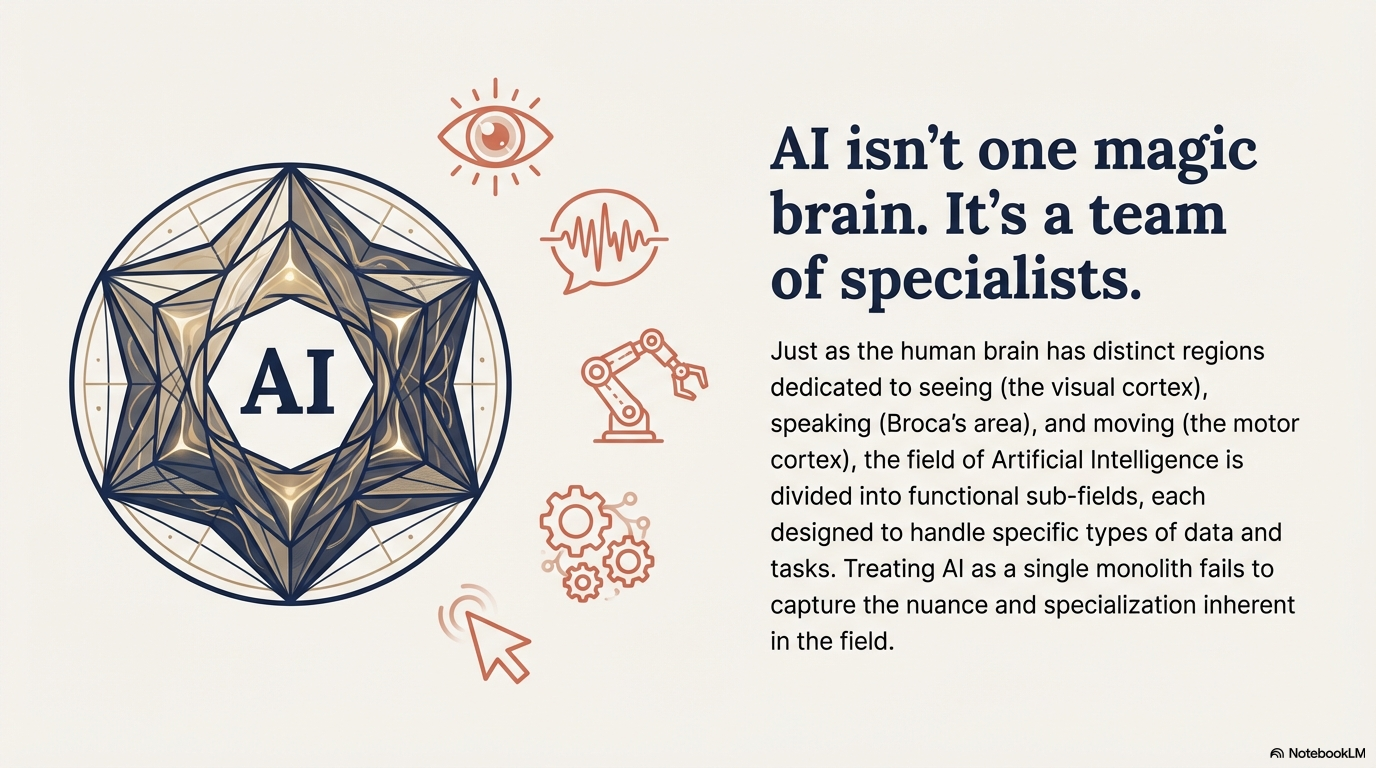
Welcome to the first lesson of Module 4. Until now, we have likely discussed Artificial Intelligence as a broad, singular concept—a "brain" capable of learning. However, treating AI as a single monolith is akin to treating "medicine" as a single pill; it fails to capture the nuance and specialization inherent in the field. Just as the human brain has distinct regions dedicated to seeing (the visual cortex), speaking (Broca's area), and moving (the motor cortex), the field of Artificial Intelligence is divided into functional sub-fields, each designed to handle specific types of data and tasks.
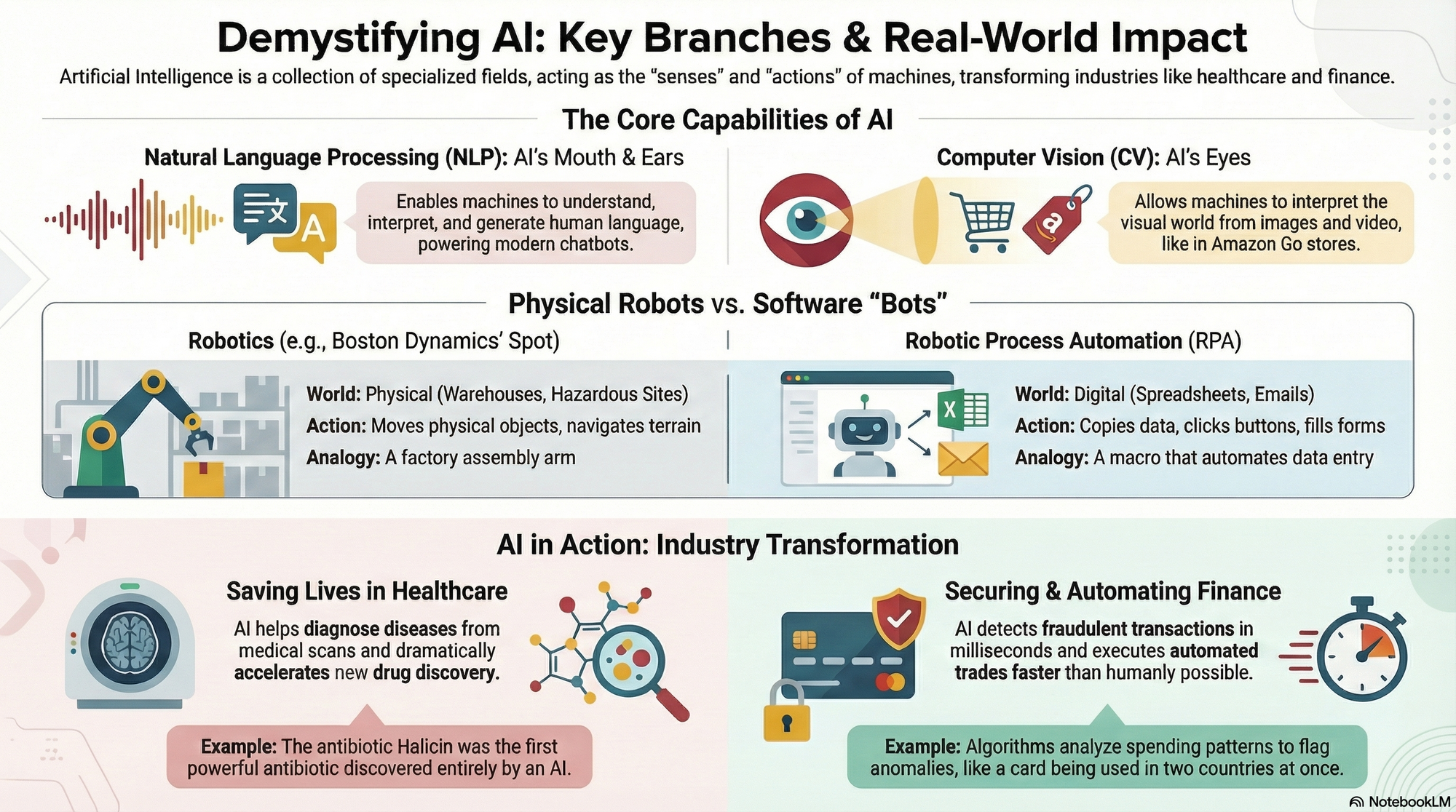
In this lesson, we will dissect AI into its primary operational capabilities. We will explore Natural Language Processing (NLP), which gives machines the power of language; Computer Vision (CV), which grants them the power of sight; and the critical distinction between the physical world of Robotics versus the digital world of Robotic Process Automation (RPA).
By the end of this lesson, you will not only understand what these terms mean but also possess the discernment to distinguish between a robot that walks across a room and a "robot" that simply clicks buttons in a spreadsheet. You will understand how machines "read" library books, "watch" security footage, and "perform" tasks that range from the mundane to the miraculous.
Slides
Explainer Video
2. Core Concepts
2.1 Natural Language Processing (NLP)
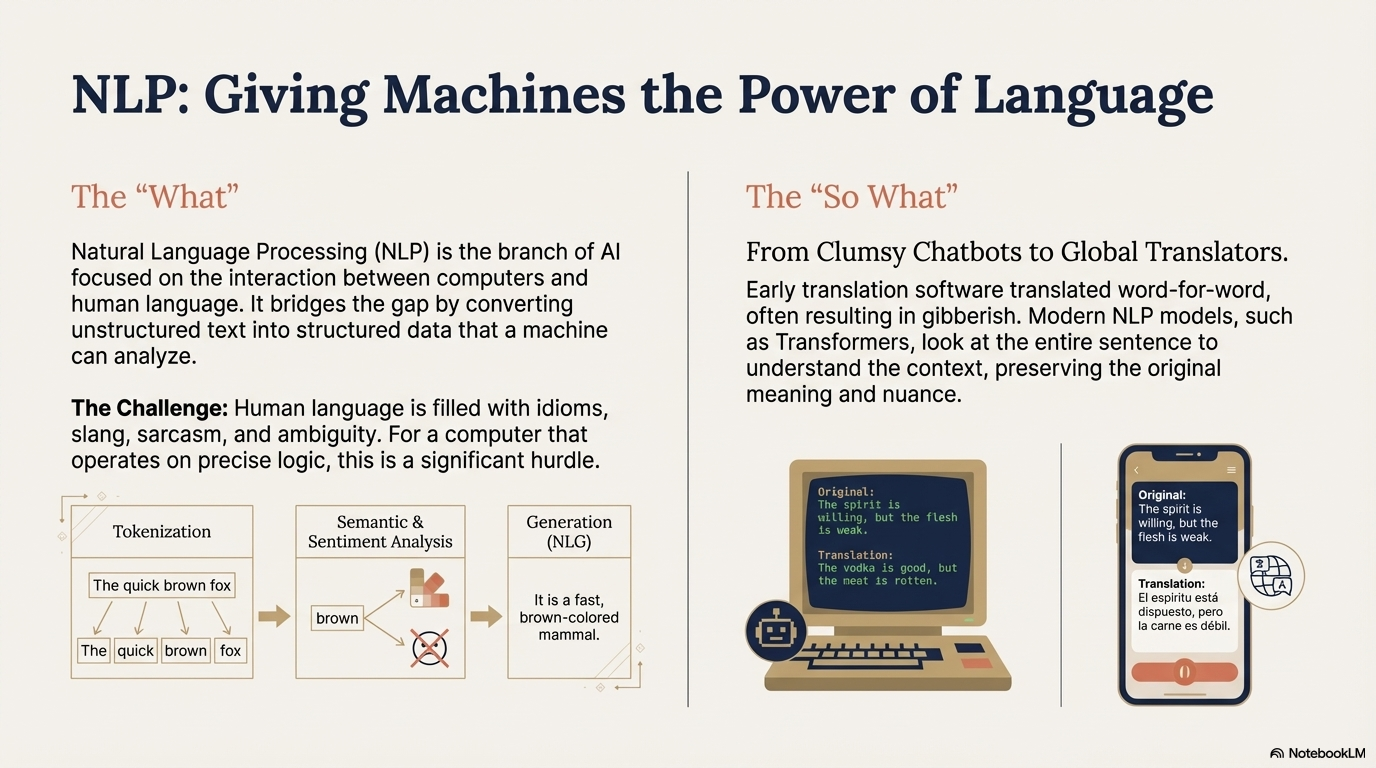
Natural Language Processing, or NLP, is the branch of AI focused on the interaction between computers and human language. It is not merely about a computer "reading" text in the way a scanner digitizes a document; it is about the machine extracting meaning, sentiment, intent, and context from words.1
The Challenge of Ambiguity
Human language is notoriously messy. It is filled with idioms, slang, sarcasm, and homonyms (words that sound the same but mean different things). For a computer, which operates on precise mathematical logic, this ambiguity is a significant hurdle. NLP bridges this gap by converting unstructured text into structured data that a machine can analyze.
The Mechanism of Understanding
At its core, computers do not understand words; they understand numbers. NLP processes language through several complex stages:
- Tokenization: The system breaks down a sentence into smaller units called "tokens." These can be individual words, sub-words, or punctuation.
- Semantic Analysis: The system analyzes the meaning of these tokens in context. For example, the word "bank" means something very different in the sentence "I sat on the river bank" versus "I deposited money at the bank." The AI looks at the surrounding words ("river" vs. "money") to determine the correct definition.1
- Sentiment Analysis: Beyond the dictionary definition, the machine determines the emotional tone behind the text. Is the user angry, happy, neutral, or sarcastic? This is crucial for customer service applications where understanding a customer's frustration is as important as understanding their request.1
- Generation (NLG): Finally, Natural Language Generation allows the system to construct coherent, grammatically correct sentences in response, moving beyond pre-written scripts to dynamic communication.
Real-World Application: The Evolution of Chatbots
Consider the customer service chatbot. In the past, these were rigid systems that looked for specific keywords. If you typed, "I want to return my shoe," and the system only knew the keyword "refund," it might fail to help you. Modern chatbots use NLP to understand that "return" and "refund" are semantically similar in this context. They identify the core intent (transaction reversal) and the object (shoe), and can even detect if you are frustrated, perhaps routing you to a human agent faster.1
Translation services like Google Translate also rely heavily on NLP. Early translation software translated word-for-word, often resulting in gibberish. Modern NLP models, such as Transformers (e.g., BERT or GPT), look at the entire sentence or paragraph at once to understand the context before translating, preserving the original meaning and nuance rather than just the vocabulary.2
2.2 Computer Vision (CV)
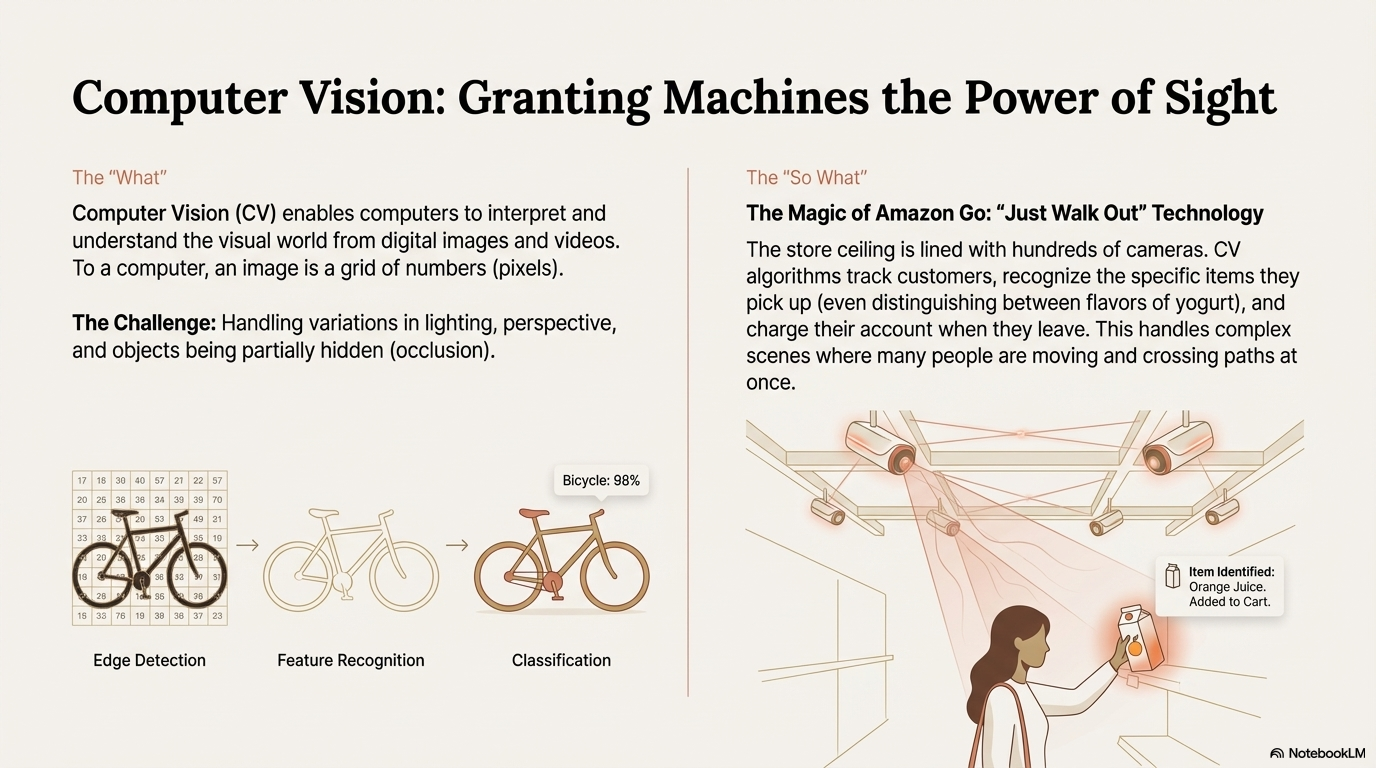
If NLP is the "mouth and ears" of AI, Computer Vision is the "eyes." This field enables computers to interpret and understand the visual world. Using digital images from cameras, videos, and even medical scanners, deep learning models can accurately identify, classify, and track objects.3
The Mechanism: Seeing in Pixels
To a computer, an image is not a picture; it is a grid of numbers. A digital photo is composed of pixels, and each pixel has a numerical value representing its color (Red, Green, Blue) and brightness. Computer Vision algorithms look for patterns in these vast grids of numbers:
- Edge Detection: The algorithm first identifies where one object ends and another begins by looking for sharp contrasts in color or brightness.
- Feature Recognition: It then looks for specific shapes or "features," like the circular curve of a tire, the sharp angle of a table corner, or the specific distance between two eyes on a face.4
- Classification: Finally, it combines these features to label the object with a probability score (e.g., "There is a 98% chance this object is a bicycle").
Case Study: Amazon Go (Just Walk Out Technology)
A prime example of Computer Vision in action is Amazon’s "Just Walk Out" technology used in Amazon Go stores. This system represents a massive leap in retail automation.
- The Problem: Traditional retail requires customers to wait in line to pay, creating friction and wasting time.
- The Solution: The ceiling of the store is lined with hundreds of cameras. When a customer enters, they scan a code to identify themselves. As they move through the store, Computer Vision algorithms track them continuously.
- The Magic: When a customer picks up an item, the system recognizes the item (visual product recognition) and the specific customer who took it (pose estimation and tracking). If they put it back, the system removes it from their virtual cart. When they leave, the system charges their account automatically. This requires the AI to distinguish between similar-looking products (e.g., two different flavors of yogurt) and handle complex scenes where many people are moving, reaching, and crossing paths at once.5
2.3 Robotics vs. Robotic Process Automation (RPA)
This is a common point of confusion for many learners. Both fields use the word "robot," but they refer to completely different entities. Understanding this distinction is vital for accurate communication in the tech space.
Robotics (Physical Machines)
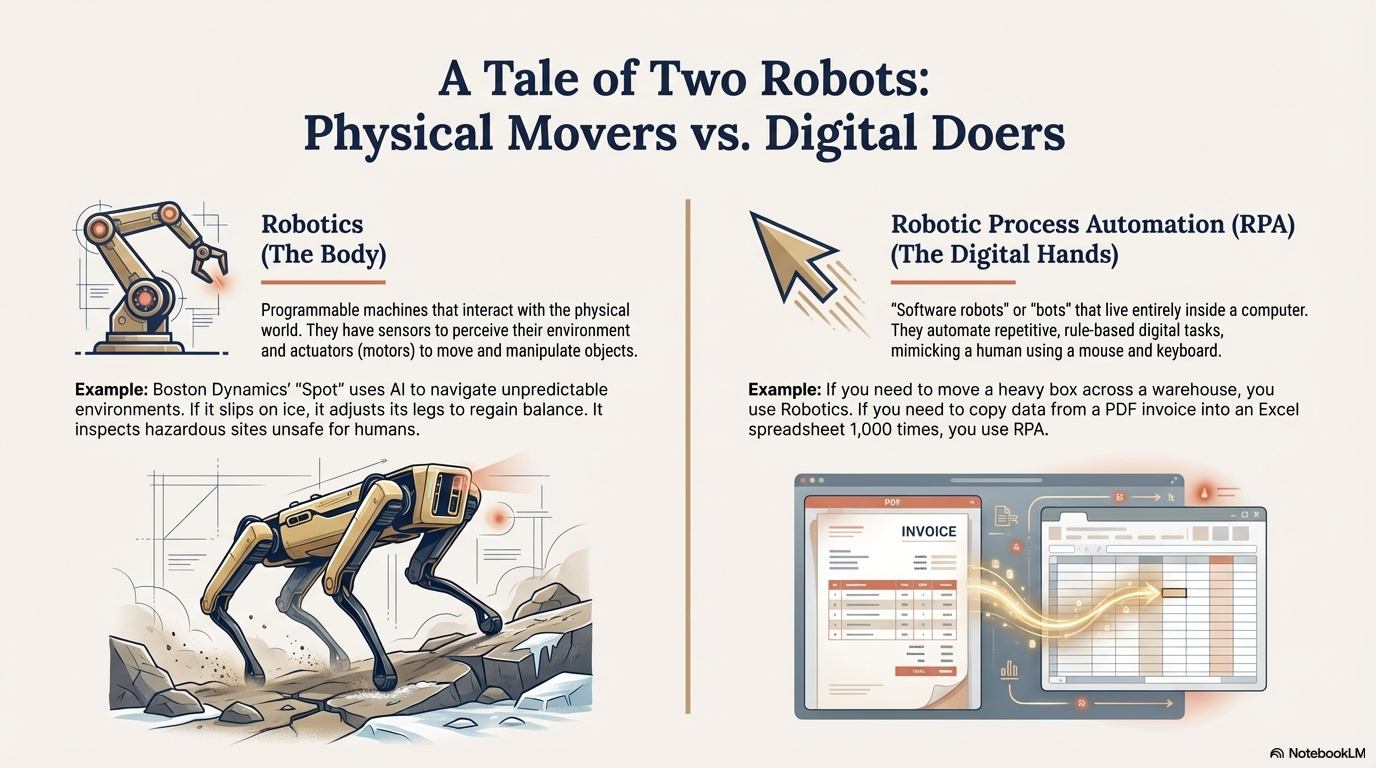
This involves programmable machines that interact with the physical world. These robots have sensors (to see, feel, or hear environment data) and actuators (motors or hydraulics to move and manipulate objects).
- The Role of AI: Not all robots use AI; some simply repeat the same motion endlessly (like an old car factory arm). However, modern robots use AI to navigate unpredictable environments.
- Example: Boston Dynamics’ "Spot" is a four-legged robot dog. It is not just a remote-controlled toy; it uses AI to perceive its surroundings. If it slips on ice, it adjusts its legs to regain balance. If it encounters stairs, it maps them and plans a path to climb safely. It is used to inspect hazardous industrial sites, such as nuclear power plants or high-voltage substations, where it is unsafe for humans to go.8
Robotic Process Automation (RPA) (Software Bots)
RPA involves "software robots" or "bots" that live entirely inside a computer. They do not have a physical body. They are programs designed to automate repetitive, rule-based digital tasks.1
- The "Rule Follower": RPA is often described as a "doer" rather than a "thinker." It follows a strict set of instructions: "Open email, download attachment, save to Folder A." It does not learn or make judgments unless it is combined with AI (a concept often called Intelligent Process Automation or IPA).11
- The Distinction: If you need to move a heavy box across a warehouse, you use Robotics. If you need to copy data from a PDF invoice into an Excel spreadsheet 1,000 times, you use RPA. RPA mimics the actions of a human using a mouse and keyboard, but it does so at lightning speed and with zero errors, provided the format of the data does not change unexpectedly.3
3. Simple Analogy or Example
Imagine a busy, high-end restaurant kitchen.
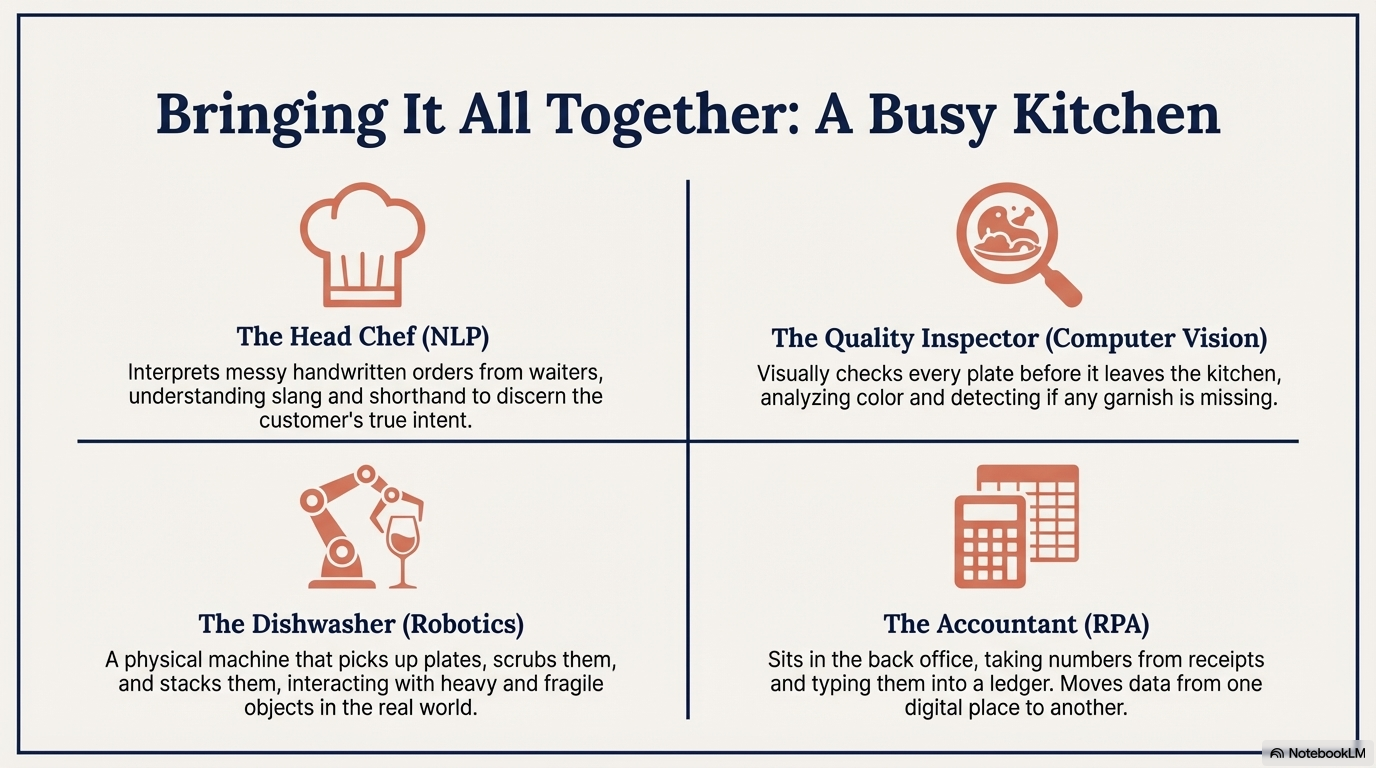
- The Head Chef (NLP): This person reads the handwritten orders from the waiters. Even if the handwriting is messy, or the waiter used shorthand slang (e.g., "Burn one" for a well-done steak), the Chef understands exactly what dish to cook and the intent behind the note. This is Natural Language Processing—interpreting intent from messy communication.
- The Quality Inspector (Computer Vision): This person stands at the pass, looking at every plate before it leaves the kitchen. They do not taste it; they look at it. They check if the steak looks burnt (color analysis) or if the garnish is missing (object detection). They are analyzing visual information to make a decision. This is Computer Vision.
- The Dishwasher (Robotics): This is a physical machine (or person in this analogy) that physically picks up plates, scrubs them, and stacks them. It interacts with the physical world, handling heavy, wet, and fragile objects. This is Robotics.
- The Accountant (RPA): This person sits in the back office. They take the receipts from the night, type the numbers into a spreadsheet, and click "Save." They do not cook, clean, or inspect food; they just move data from one place to another following a strict process. This is Robotic Process Automation.
4. Key Takeaways
- NLP allows computers to read, understand, and generate human language, enabling technologies like chatbots and real-time translation services.
- Computer Vision enables computers to "see" by analyzing pixels in images and video to detect objects and patterns, as seen in Amazon Go stores.
- Robotics refers to physical machines moving in the real world (e.g., Boston Dynamics' Spot) that use AI to navigate and manipulate physical objects.
- RPA refers to software scripts that automate repetitive digital tasks (e.g., data entry) and typically follows strict rules without "thinking" or learning.
Lesson 4.2: Expert Systems and Fuzzy Logic
1. Introduction
In the previous lesson, we looked at how AI perceives the world (seeing via Computer Vision and reading via NLP). In this lesson, we will look at how AI reasons. Specifically, we will explore two foundational concepts that helped pave the way for modern AI: Expert Systems and Fuzzy Logic.
While these technologies are often considered "Good Old-Fashioned AI" (GOFAI) and predate the current boom in Deep Learning, they remain critical for understanding how we teach machines to make decisions. They are also still widely used in industrial control systems and specialized diagnostic tools. Expert Systems attempt to clone the knowledge of a human specialist, while Fuzzy Logic teaches computers to understand that the real world is not always black and white, but often exists in shades of grey.
2. Core Concepts
2.1 Expert Systems
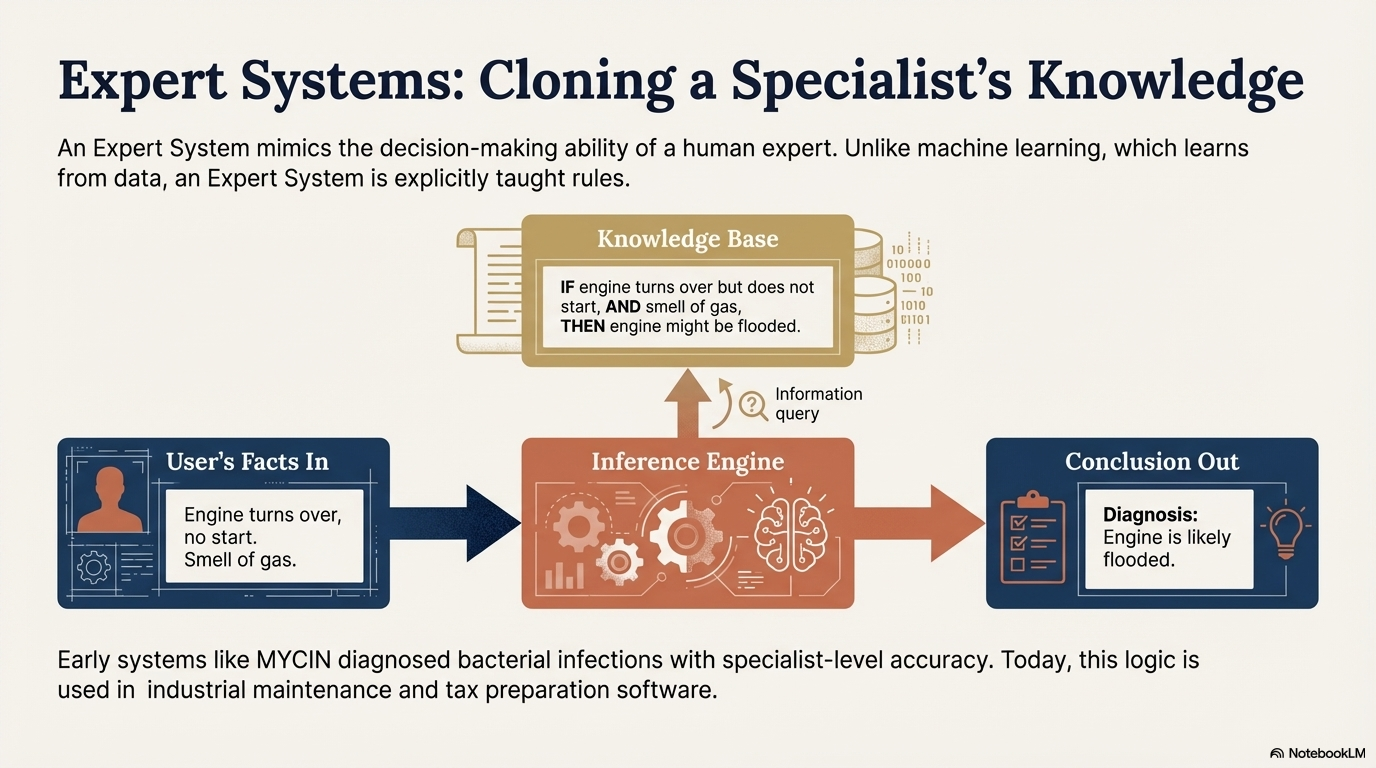
An Expert System is one of the earliest and most successful forms of AI, rising to prominence in the 1970s and 1980s. It is a computer program designed to solve complex problems and mimic the decision-making ability of a human expert.13 Unlike modern machine learning, which "learns" patterns from vast amounts of data, an Expert System is "taught" rules explicitly by human experts.
The Architecture
An Expert System relies on a distinct architecture that separates knowledge from reasoning. It has two main components:
- The Knowledge Base: This is a library of facts and rules. Imagine it as a digital textbook containing everything a specific expert knows about their field. It is populated by interviewing human experts. For example, in a car diagnostic system, a rule might be: "IF the car engine turns over but does not start, AND there is a smell of gas, THEN the engine might be flooded".13
- The Inference Engine: This is the "brain" or the reasoning component of the system. It applies the logical rules from the Knowledge Base to the specific data provided by the user. It looks at the current situation (the user's problem) and searches the Knowledge Base for a matching rule to deduce a solution.16
Reasoning Methods: Forward vs. Backward Chaining
The Inference Engine typically uses one of two methods to reach a conclusion:
- Forward Chaining: This is data-driven reasoning. The system starts with the known facts and applies rules to work toward a conclusion.
- Example: Fact A: "Patient has a runny nose." Fact B: "Patient has a fever." -> The system searches for rules that include these symptoms and concludes: "Patient likely has the flu".16
- Backward Chaining: This is goal-driven reasoning. The system starts with a hypothesis (a goal) and works backward to see if the facts support it.
- Example: Hypothesis: "Does the patient have the flu?" -> The system checks the rule for flu, which requires a fever. It then asks the user: "Do you have a fever?" If the answer is yes, the hypothesis is supported.16
Real-World Application
Early Expert Systems were groundbreaking in medicine. MYCIN, developed in the 1970s, was designed to diagnose bacterial infections. A doctor would input symptoms and lab results, and MYCIN would use its rule base to suggest the likely bacteria and the correct antibiotic dosage. It performed as well as specialists in limited trials.18 Today, similar logic is used in industrial maintenance (diagnosing machine faults) and tax preparation software (guiding users through complex tax codes).19
2.2 Fuzzy Logic
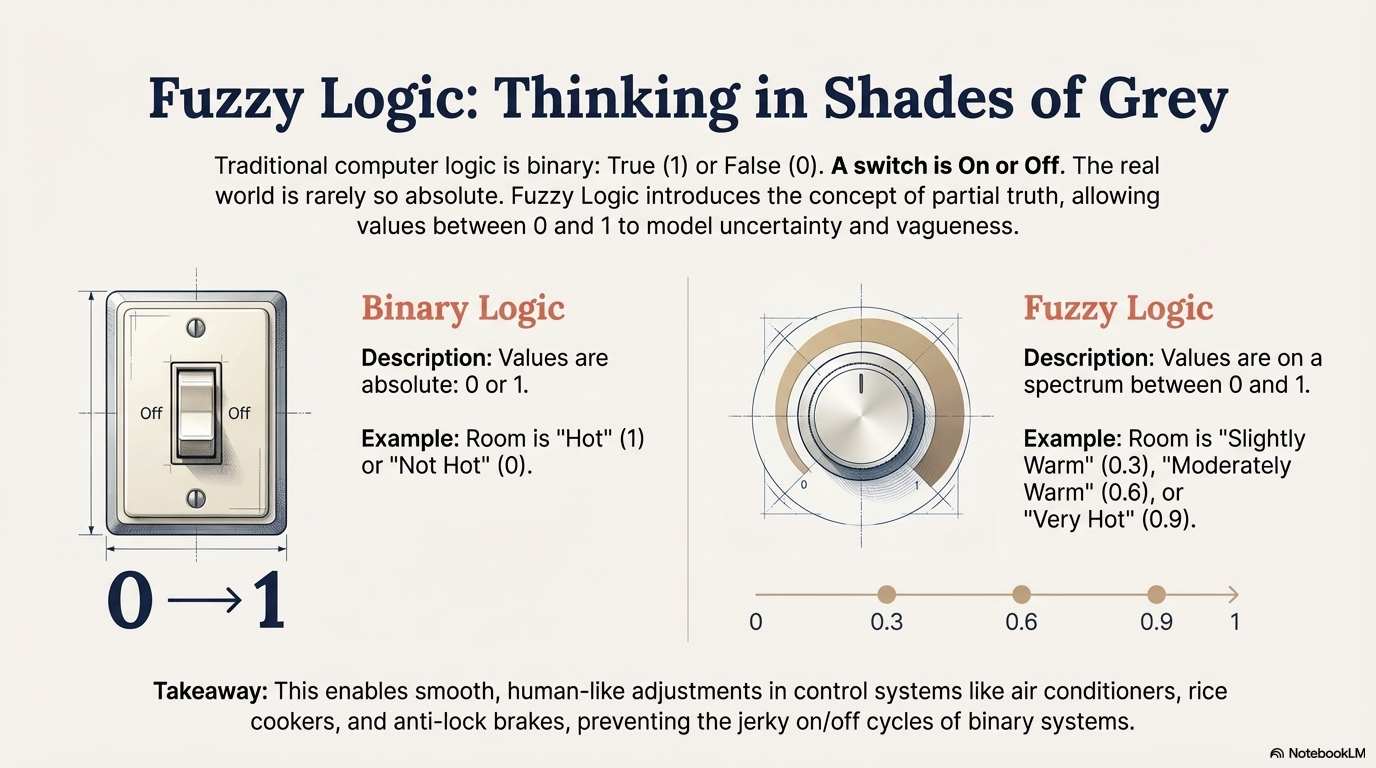
Traditional computer logic is "Binary" or "Boolean." This means everything is either True (1) or False (0). A switch is On or Off. A statement is Right or Wrong. While this is perfect for mathematics, the real world is rarely so absolute.
For example, is a man who is 5 feet 9 inches tall "Tall"? In binary logic, you would have to set a strict mathematical cutoff. If you set the cutoff at 6 feet, then a man who is 5'11" is "Short" (0), and a man who is 6'0" is "Tall" (1). This rigidness causes problems in AI reasoning, as the difference between the two men is negligible, yet the classification is opposite.21
The "Degree of Truth"
Fuzzy Logic introduces the concept of partial truth. Instead of being just 0 or 1, a value can be any real number between 0 and 1. This allows the computer to model uncertainty and vagueness.
- In Fuzzy Logic, a man who is 6'0" might be "0.9 Tall."
- A man who is 5'11" might be "0.8 Tall."
- A man who is 5'6" might be "0.4 Tall."
Why It Matters: Control Systems
This nuance is crucial for control systems that require smooth operation.
- Binary Approach: An air conditioner using binary logic would measure the temperature. If the target is 70°F and the room is 71°F, it treats the room as "Hot" (1) and blasts cold air at full power. When it hits 70°F, it turns off completely. This leads to a jerky, uncomfortable cycle of freezing and warming.
- Fuzzy Approach: An air conditioner using Fuzzy Logic senses that the room is "slightly warm" (perhaps a 0.3 on the "Hot" scale). It therefore runs the fan at "low speed." As the temperature rises and becomes "moderately warm," the fan speed increases smoothly. This mimics how a human would adjust a dial, rather than just flipping a switch.22
3. Simple Analogy or Example
The Expert System Analogy: The Cookbook
Imagine you are cooking a meal, but you do not know how to cook. You open a massive, detailed cookbook (The Knowledge Base).
- You look at the ingredients you have on your counter: eggs, flour, milk (The Facts).
- You search the index of the book for recipes that use these specific ingredients (The Inference Engine).
- The book tells you: "Make Pancakes" (The Conclusion).If you are missing an ingredient, the book (Expert System) simply says, "Cannot make pancakes." It follows the rules strictly and cannot improvise a new recipe if you have an ingredient it does not know about.
The Fuzzy Logic Analogy: The Dimmer Switch
- Binary Logic: This is like a standard light switch. The lights are either blindingly bright (1) or pitch black (0). There is no middle ground. You are either in the dark or in the light.
- Fuzzy Logic: This is like a dimmer switch. You can set the light to 10% brightness for a romantic dinner, 50% brightness for watching TV, or 100% brightness for cleaning the room. It allows for smooth transitions and precision that matches human preference and the reality of the situation.
4. Key Takeaways
- Expert Systems mimic human decision-making using a Knowledge Base (facts/rules) and an Inference Engine (logic processor) to deduce solutions.
- They rely on IF-THEN rules and are excellent for structured problem-solving like medical diagnosis or engine troubleshooting, but they struggle with new situations not in their database.
- Fuzzy Logic allows computers to handle vague or imprecise concepts (like "warm" or "tall") by using degrees of truth (values between 0 and 1) rather than strict True/False binary.
- Fuzzy logic is essential for systems that require smooth, human-like adjustments, such as temperature control systems, anti-lock braking systems (ABS), and rice cookers.
Lesson 4.3: AI in Finance (FinTech)
1. Introduction
The financial sector was one of the earliest and most aggressive adopters of Artificial Intelligence. Money, after all, is essentially just data—numbers moving from one ledger to another. This abstract nature makes finance the perfect playground for AI algorithms. Unlike a robot that has to navigate a messy physical world, a financial AI navigates a world of pure information.
In this lesson, we will explore how AI protects your money through advanced Fraud Detection, how it grows capital through high-speed Algorithmic Trading, and how it decides who gets access to capital through Risk Assessment. We will see how machines can analyze patterns faster than any human, spotting a thief or a profitable trade in mere milliseconds, fundamentally changing the speed and security of the global economy.
2. Core Concepts
2.1 Fraud Detection
Financial fraud is a massive global issue, costing the economy billions of dollars annually. As digital transactions increase, so do the opportunities for theft. Traditional methods of stopping fraud relied on static, rule-based systems (e.g., "If a transaction is over $10,000, flag it for review"). However, criminals are intelligent; they learn these rules and find ways to bypass them, such as making multiple smaller transactions just under the limit.
AI as the Detective
AI systems, particularly those using Machine Learning, have revolutionized this field by moving from static rules to dynamic pattern recognition. These systems analyze transaction patterns in real-time, looking at thousands of data points instantly:
- Contextual Analysis: The AI looks at the location, time of day, device used, and even the typing speed of the user.2
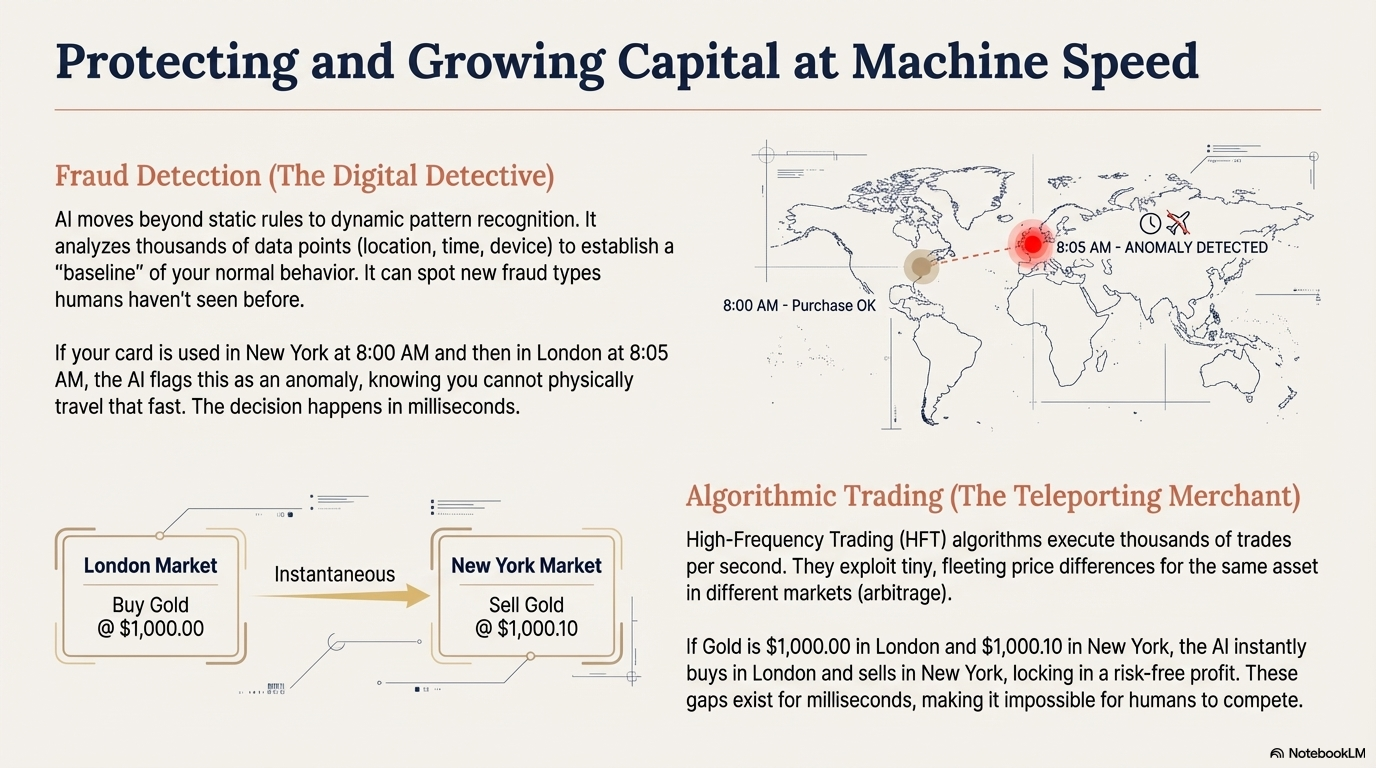
- Anomaly Detection: It establishes a "baseline" of normal behavior for every user. If you typically buy a coffee in New York at 8:00 AM, and suddenly your card is used to buy expensive electronics in London at 8:05 AM, the AI flags this as an anomaly. It knows you cannot physically travel between those two points in five minutes.
- Unsupervised Learning: Crucially, AI can use unsupervised learning to spot new types of fraud that humans have not seen before. By clustering data, it can notice that a sudden spike in small transactions from a specific region looks "weird," even if it does not break any existing rule.2
Speed and Accuracy
These decisions happen in milliseconds. AI can block a transaction before the receipt even prints at the terminal.
- Case Study (PayPal/Mastercard): PayPal uses deep learning models to analyze user behavior (down to how you move your mouse on the screen) to distinguish between a legitimate user and a bot or hacker. This has not only stopped more fraud but also significantly reduced "false positives" (situations where a legitimate card is wrongly declined), which is a major annoyance for customers.2
2.2 Algorithmic Trading
Algorithmic trading (often called "Algo-trading") involves using computer programs to execute trades automatically based on pre-set instructions or learned strategies. This is not just about convenience; it is about speed and volume that are physically impossible for humans.
High-Frequency Trading (HFT)
A subset of algo-trading is High-Frequency Trading. Here, AI algorithms execute thousands of trades per second. They analyze market data faster than a human can blink.
- The Strategy: If a stock price dips for a fraction of a second due to a large sell order, the AI buys it and sells it moments later when the price corrects. The profit per share might be a fraction of a penny, but if you do this millions of times a day, the profits are substantial.2
- Sentiment Analysis in Trading: Advanced trading algorithms also use NLP to read news headlines, earnings reports, and even social media feeds (like Twitter/X) in real-time. If a company announces a breakthrough, the AI can buy the stock before a human trader has even finished reading the headline.25
Arbitrage
This is a specific strategy where AI exploits price differences for the same asset in different markets.
- Example: If Gold is selling for $1,000.00 in London and $1,000.10 in New York, the AI instantly buys it in London and sells it in New York, locking in a risk-free profit of 10 cents. Because these gaps exist for only seconds (or milliseconds) before the market corrects, humans cannot compete with the speed of AI. This practice helps keep global markets efficient and prices consistent.26
2.3 Risk Assessment and Alternative Data
When you apply for a loan or a credit card, the bank needs to know one thing: will you pay them back? Traditionally, this "Risk Assessment" was done by looking at your credit score and salary. This method is reliable but exclusive; it shuts out many people (like young people, immigrants, or gig workers) who are responsible with money but lack a long credit history.
The "Alternative Data" Revolution
AI allows lenders to look at "Alternative Data" to assess risk. Instead of just looking at a credit score, AI models can ingest vast amounts of unstructured data to build a profile of trustworthiness:
- Utility Payments: Do you pay your phone and electricity bill on time?
- Rental History: Have you ever missed a rent payment?
- Cash Flow: Does your bank account balance stay positive, or do you frequently bounce checks?
- Behavioral Data: Some experimental models even analyze digital footprints or shopping patterns (e.g., people who buy premium birdseed might be statistically more likely to pay back loans—a famous, if odd, correlation found by data scientists).2
By processing this data, AI creates a more holistic view of a borrower. This allows banks to lend to "thin-file" customers (those with little credit history) without taking on excessive risk. It democratizes access to finance, though it also raises ethical questions about privacy and data bias that must be carefully managed.28
3. Simple Analogy or Example
The Super-Speed Stock Broker
Imagine a human stock trader named "Bob." Bob sits at his desk, reads the Wall Street Journal, and watches the TV news. When he sees a positive story about a company, he thinks about it, picks up the phone, and places an order. This process takes Bob maybe 30 seconds to a minute.
Now imagine an AI trader named "Blitz."
- Blitz reads every news article, tweet, and financial report in the world simultaneously (NLP).
- Blitz watches every stock market in every country at the same time.
- Blitz spots that a company in Japan just announced a breakthrough product.
- Before Bob has even finished reading the first word of the headline, Blitz has already bought the stock, waited for the price to rise by 0.1% as other computers react, and sold it for a profit.
- Blitz does this 10,000 times before Bob finishes his morning coffee.
The Arbitrage Analogy: The Teleporting Merchant
Imagine two markets across the street from each other.
- Market A sells apples for $1.00.
- Market B is buying apples for $1.10.A human merchant would have to buy apples at Market A, put them in a basket, walk across the street, and sell them at Market B. They might make a few dollars before Market A raises its price or Market B lowers its offer.An AI is like a teleportation tube that instantly sucks all the cheap apples from Market A and shoots them into Market B until the prices equalize. It extracts the profit instantly and ensures that apples cost roughly the same on both sides of the street.
4. Key Takeaways
- Fraud Detection: AI analyzes transaction patterns in milliseconds to block suspicious activities (e.g., impossible travel speeds, unusual spending) without disrupting legitimate users.
- Algorithmic Trading: AI executes trades at superhuman speeds (High-Frequency Trading) and exploits tiny price gaps between markets (Arbitrage), reacting to news and data faster than any human.
- Risk Assessment: AI helps lenders evaluate borrowers by using Alternative Data (rent, phone bills, cash flow) rather than just credit scores, increasing access to loans for underserved populations.
- Speed is Key: In Finance, the primary advantage of AI is its ability to process vast datasets and execute decisions faster than humanly possible, turning time into money.
Lesson 4.4: AI in Healthcare
1. Introduction
Perhaps the most impactful application of AI is in Healthcare. While finance uses AI to save money, healthcare uses AI to save lives. The integration of Artificial Intelligence into medicine is transforming the field from a reactive one—where we treat you only after you show symptoms—to a proactive, predictive one.
In this final lesson, we will look at three pillars of AI in healthcare: Diagnostics (finding the disease), Drug Discovery (creating the cure), and Administrative/Robotic Support (managing the treatment). We will discuss real stories, like the discovery of the antibiotic Halicin, to see this power in action. We will understand how AI acts as a "second set of eyes" for doctors and a "super-researcher" for scientists.
2. Core Concepts
2.1 Diagnostics: The AI Radiologist
Medical imaging—X-rays, MRIs, CT scans—produces highly detailed pictures of the inside of the body. Radiologists are doctors who spend years training to spot tiny anomalies in these images, such as tumors, fractures, or bleeds. However, radiologists are human; they can get tired, distracted, or simply miss a tiny detail in a complex image.
Computer Vision Saves Lives
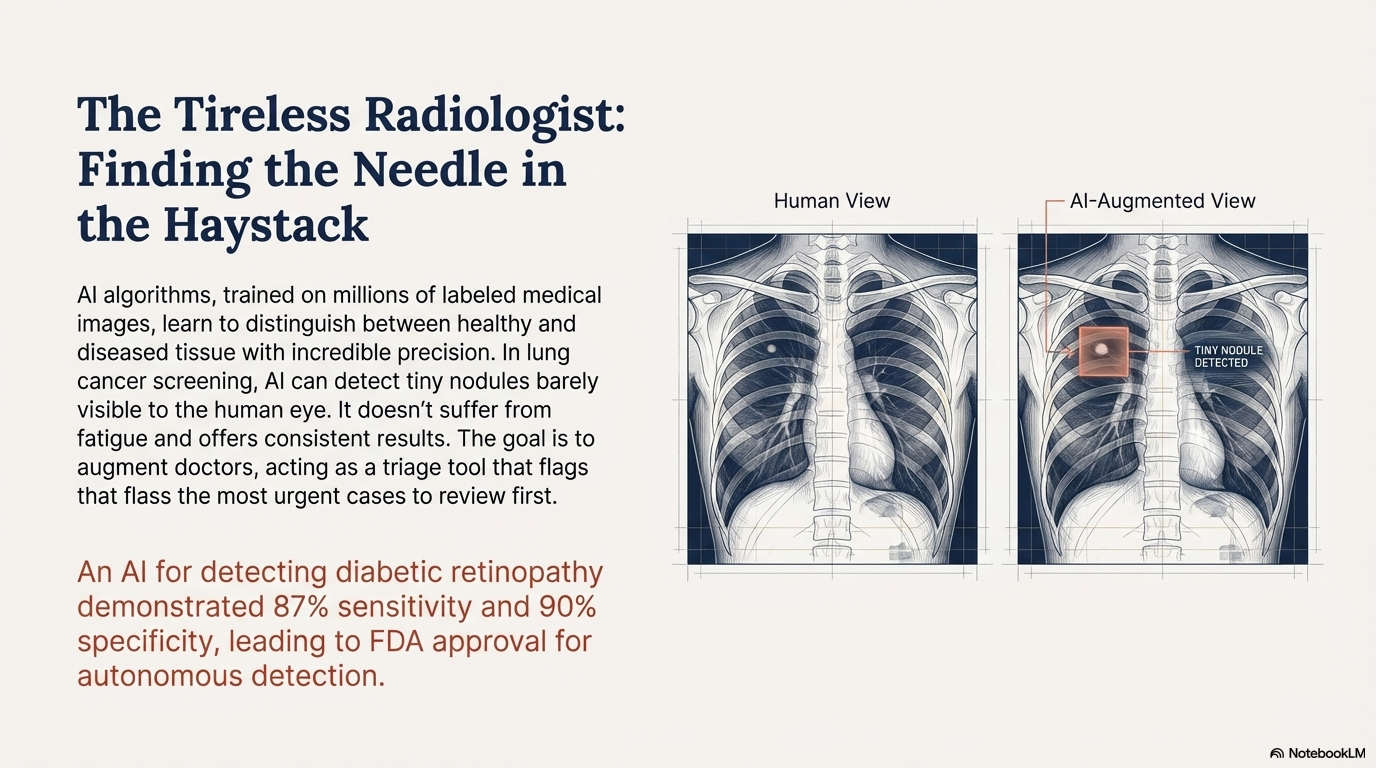
AI algorithms, specifically those using Deep Learning (Convolutional Neural Networks), are trained on millions of medical images that have been labeled by expert doctors. They learn to distinguish between healthy tissue and diseased tissue with incredible precision.30
- Pattern Recognition: In lung cancer screening, for example, AI can detect tiny nodules that are barely visible to the human eye. It does not suffer from fatigue and offers consistent results regardless of the time of day.
- Performance Metrics: Studies have shown that AI can match or even outperform human radiologists in detecting pneumonia, skin cancer, and breast cancer. For instance, an AI algorithm for detecting diabetic retinopathy (eye damage from diabetes) demonstrated 87% sensitivity and 90% specificity, leading to FDA approval for autonomous detection.31
- Triage Support: The goal is generally not to replace the doctor but to augment them. The AI can act as a triage tool, scanning all images and flagging the most urgent cases for the doctor to review first. This reduces the "time to diagnosis" for critical patients.32
2.2 Drug Discovery: The Story of Halicin
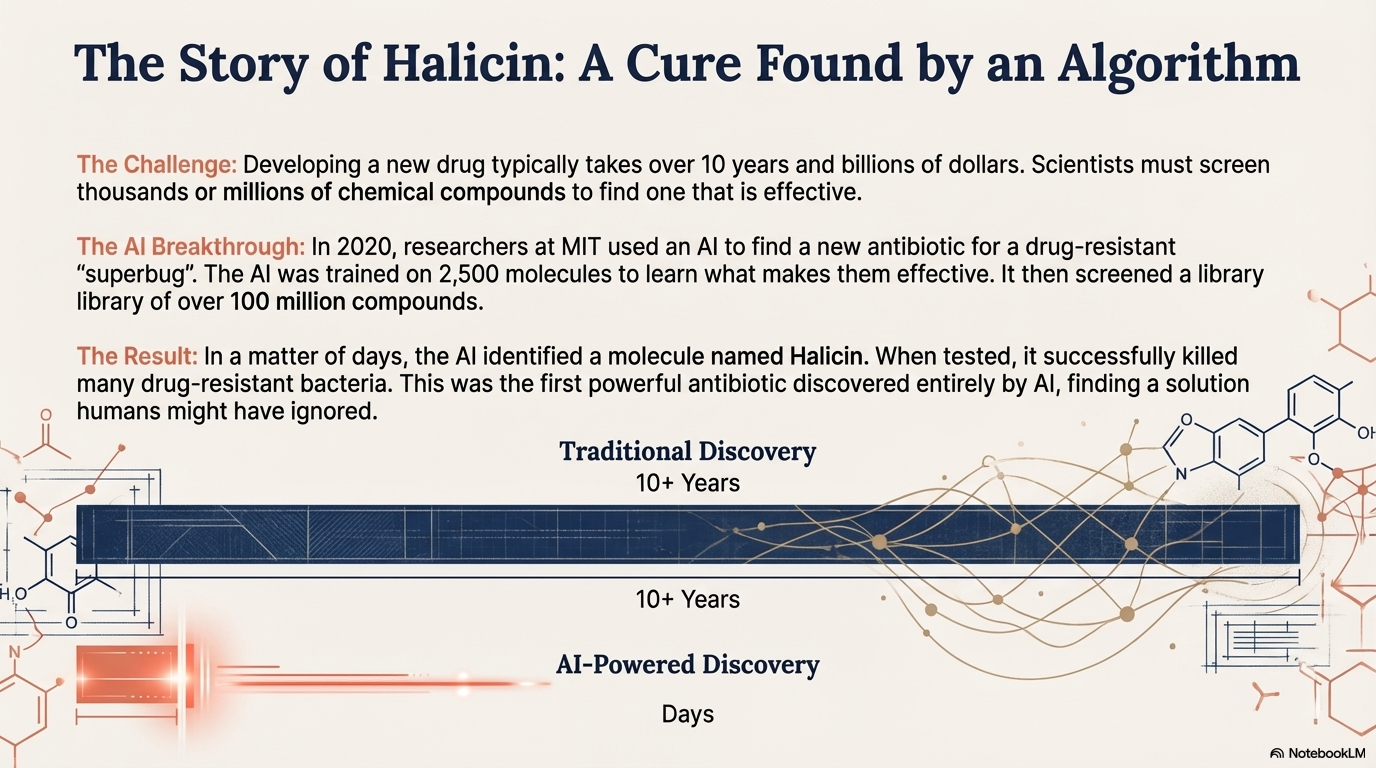
Developing a new drug is an incredibly slow, risky, and expensive process. It typically takes over 10 years and costs billions of dollars to bring a new medicine to market. Scientists must test thousands of chemical compounds to find one that is effective against a disease but safe for humans.
AI Accelerates the Search
AI can simulate how different molecules interact with viruses or bacteria, effectively "testing" them virtually (in silico) rather than physically in a petri dish. This speeds up the screening process from years to days.30
Case Study: Halicin
In 2020, researchers at MIT used an AI model to search for a new antibiotic. The goal was to kill a dangerous strain of bacteria (Acinetobacter baumannii) that was resistant to all known drugs—a "superbug."
- The Process: The AI was trained on the molecular structures of 2,500 drugs to learn what makes a molecule effective against bacteria.
- The Search: The researchers then fed the AI a library of over 100 million chemical compounds to screen.34
- The Discovery: In a matter of days, the AI identified a molecule that looked nothing like traditional antibiotics (which humans would have ignored) but was predicted to be highly effective.
- The Result: Researchers named the molecule Halicin (after HAL 9000 from the movie 2001: A Space Odyssey). When tested in the lab, Halicin successfully killed many drug-resistant bacteria, including C. difficile and E. coli. This was a landmark moment: the first time a powerful antibiotic was discovered entirely by AI, finding a solution humans might never have thought to look for.34
2.3 Robotics and Administrative Automation
Robotic Surgery: The da Vinci System
When we talk about robots in surgery, we are usually referring to "robot-assisted surgery." The most famous example is the da Vinci Surgical System.
- How It Works: It is not an autonomous robot that operates by itself. Instead, it is a sophisticated tool controlled by a surgeon. The surgeon sits at a console across the room and looks into a 3D viewer. They move hand controls, and the robot arms inside the patient mimic these movements.37
- The Advantage: The robot scales down the surgeon's movements (a 1-inch move of the hand becomes a tiny move of the instrument) and filters out any hand tremors. This allows for superhuman precision, smaller incisions, less bleeding, and faster recovery times for patients.39
Administrative Automation
While less glamorous than robots, administrative AI is vital. A huge portion of healthcare costs goes toward paperwork. AI and NLP are used to:
- Transcribe Notes: Listen to doctor-patient conversations and automatically type up medical notes.
- Predict Staffing Needs: Analyze historical data to predict how many patients will arrive at the Emergency Room on a Friday night, ensuring the right number of nurses are on duty.
- Reduce Errors: Check prescriptions against patient allergies to prevent dangerous drug interactions.30
3. Simple Analogy or Example
The "Needle in a Haystack" Analogy (Drug Discovery)
Imagine you are looking for a single gold needle in a haystack the size of a mountain.
- Traditional Research: You have a team of people picking through the hay, piece by piece. It takes a lifetime, and they might miss it.
- AI Research: You use a giant, high-powered metal detector that scans the entire mountain in one hour. It beeps loudly at one specific spot. You dig there, and you find the needle. The AI did not "create" the needle, but it told you exactly where to look, saving you years of wasted effort.
The "Super-Lens" Analogy (Diagnostics)
Imagine a doctor looking at a Where's Waldo? book, trying to find Waldo (the tumor).
- The doctor is very good, but the page is crowded with thousands of characters, and the doctor has been looking at pages all day. They are tired. They might miss him.
- The AI is like a digital overlay that instantly highlights Waldo in a bright red box the moment the page is turned. The doctor still looks and confirms, "Yes, that is Waldo," but the AI ensures he is never missed and allows the doctor to check the page in seconds rather than minutes.
4. Key Takeaways
- Diagnostics: AI uses Computer Vision to analyze medical images (X-rays, MRIs) to detect diseases like cancer earlier and more accurately than before, acting as a tireless second opinion.
- Drug Discovery: AI dramatically speeds up the search for new medicines by simulating molecular interactions, as seen in the discovery of the antibiotic Halicin, which was found in days rather than years.
- Robotic Surgery: Systems like the da Vinci robot allow surgeons to operate with superhuman precision and stability, filtering out hand tremors, though the human remains in full control.
- Administrative AI: Automates scheduling, note-taking, and staffing predictions, freeing up doctors to spend less time on paperwork and more time with patients.
Conclusion to Module 4
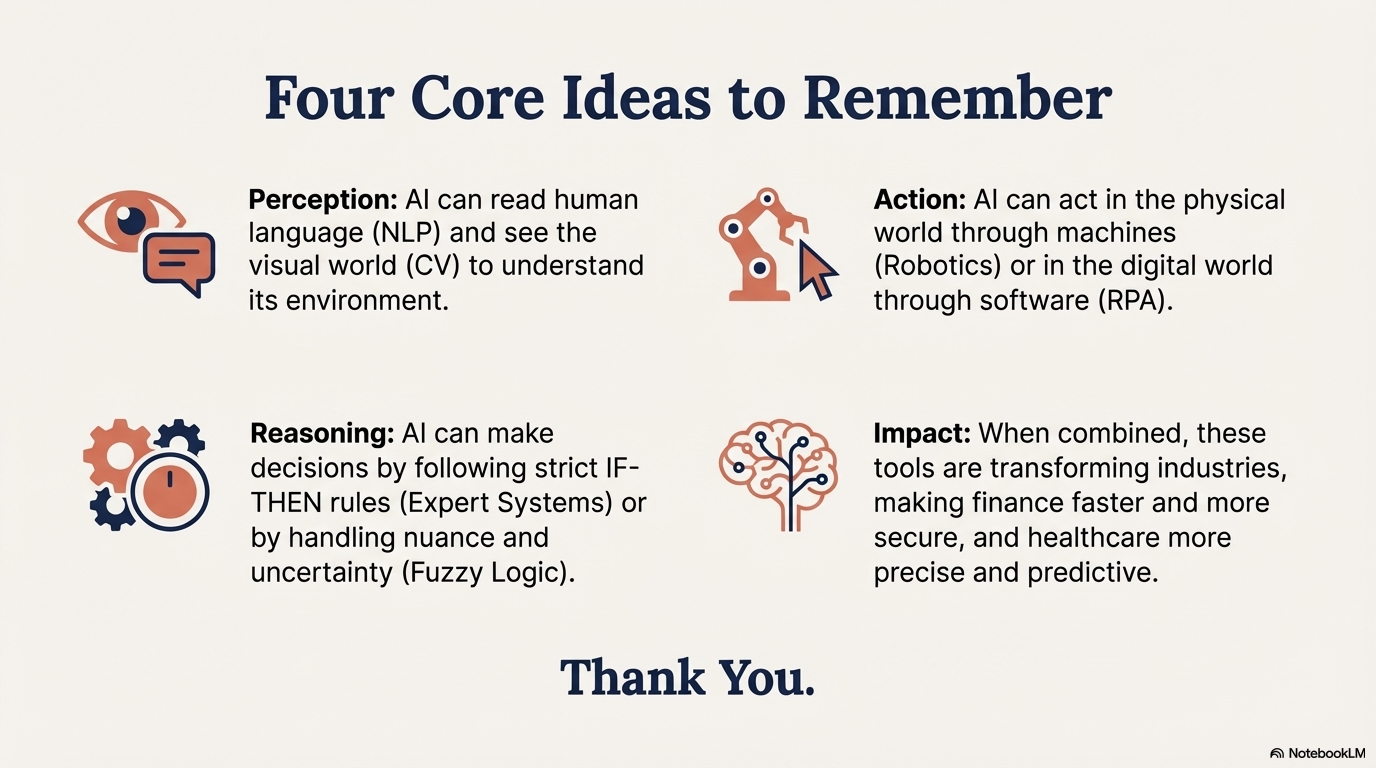
In this module, we have journeyed through the specialized branches of Artificial Intelligence. We moved from the "senses" of AI—NLP (reading/speaking) and Computer Vision (seeing)—to its "body" in Robotics versus RPA. We explored the logical foundations of Expert Systems and Fuzzy Logic, which taught us that not all computing is binary and that machines can reason with uncertainty.
Finally, we witnessed the tangible power of these technologies in the real world. In Finance, AI is the invisible guardian of our transactions and the engine of modern markets, turning time into value. In Healthcare, it is the new microscope and the new chemist, helping us find cures and treat patients with unprecedented precision.
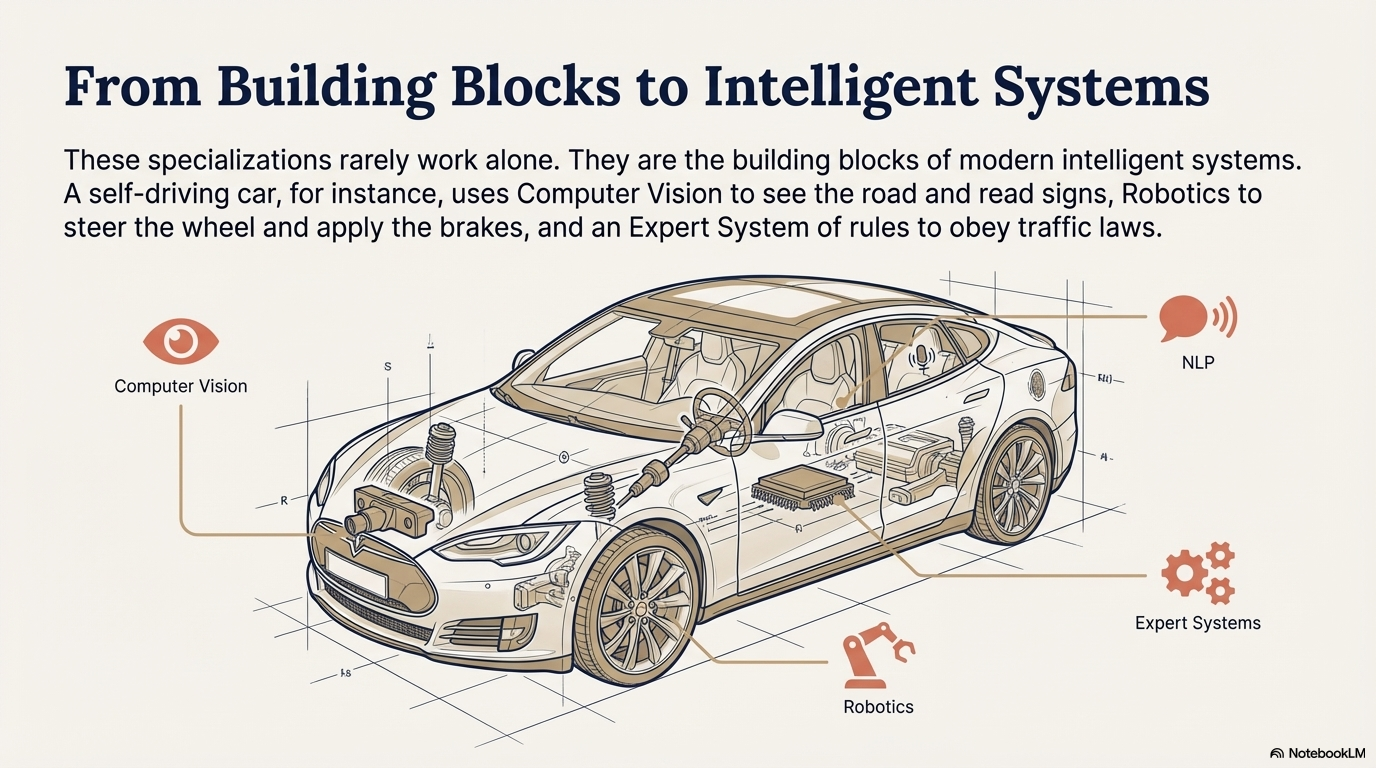
As you move forward in your learning, remember that these are not separate technologies but tools that often work together. A self-driving car, for instance, uses Computer Vision to see the road, Robotics to steer the wheel, and an Expert System of rules to obey traffic laws. Understanding these branches individually is the key to understanding the complex, intelligent systems of the future.
Further Reading
- RPA vs. AI and NLP: What's the Difference? - Calabrio, accessed December 11, 2025, https://www.calabrio.com/wfo/customer-interaction-analytics/rpa-vs-ai-nlp/
- AI in Finance: Fraud Detection, Algorithmic Trading, and Risk ..., accessed December 11, 2025, https://ijabs.niilmuniversity.ac.in/wp-content/uploads/2025/08/47.-AI-in-Finance.pdf
- What is Robotic Process Automation (RPA)? | IBM, accessed December 11, 2025, https://www.ibm.com/think/topics/rpa
- Is RPA AI? Understanding the Difference Between AI vs. RPA vs. ML - Tungsten Automation, accessed December 11, 2025, https://www.tungstenautomation.com/learn/blog/rpa-vs-ml-vs-ai-comparison
- How generative AI helps Amazon eliminate checkout lines and revolutionize the shopping experience, accessed December 11, 2025, https://www.aboutamazon.com/news/retail/how-does-amazon-just-walk-out-work
- Just Walk Out Technology - AWS, accessed December 11, 2025, https://aws.amazon.com/just-walk-out/
- Elevate your retail experience with Just Walk Out technology | AWS for Industries, accessed December 11, 2025, https://aws.amazon.com/blogs/industries/elevate-your-retail-experience-with-just-walk-out-technology/
- Spot | Boston Dynamics, accessed December 11, 2025, https://bostondynamics.com/products/spot/
- A Retrospective on Uses of Boston Dynamics' Spot Robot, accessed December 11, 2025, https://bostondynamics.com/blog/retrospective-on-boston-dynamics-spot-robot-uses/
- Watch Spot the robot dog nail a triple backflip - Popular Science, accessed December 11, 2025, https://www.popsci.com/technology/robot-dog-backflip-boston-dynamics/
- IPA versus RPA – What's the difference | Deloitte Netherlands, accessed December 11, 2025, https://www.deloitte.com/nl/en/services/tax/perspectives/bps-ipa-versus-rpa-whats-the-difference.html
- RPA vs. AI - Robotic Process Automation vs Artificial Intelligence - Appian, accessed December 11, 2025, https://appian.com/learn/topics/robotic-process-automation/rpa-vs-ai
- Expert system - Wikipedia, accessed December 11, 2025, https://en.wikipedia.org/wiki/Expert_system
- Knowledge base | computer science - Britannica, accessed December 11, 2025, https://www.britannica.com/technology/knowledge-base
- What are the different components of an expert system? - GeeksforGeeks, accessed December 11, 2025, https://www.geeksforgeeks.org/artificial-intelligence/what-are-the-different-components-of-an-expert-system/
- Expert Systems: A Comprehensive Guide | Lenovo US, accessed December 11, 2025, https://www.lenovo.com/us/en/knowledgebase/expert-systems-a-comprehensive-guide/
- Breaking Down the Key Components of Expert Systems - LIS ..., accessed December 11, 2025, https://lis.academy/information-processing-retrieval/breaking-down-key-components-expert-systems/
- Expert Systems 7.1 Definitions and Examples 7.2 Design of An Expert System, accessed December 11, 2025, https://people.computing.clemson.edu/~goddard/texts/artIntGame/chapA7.pdf
- Car Problem Diagnosis Using Rule-Based Expert System - ResearchGate, accessed December 11, 2025, https://www.researchgate.net/profile/Hasanuddin_Djamil/publication/330576319_Car_Problem_Diagnosis_Using_Rule-Based_Expert_System/links/5c4924ad92851c22a38c1ec5/Car-Problem-Diagnosis-Using-Rule-Based-Expert-System.pdf
- Machine Diagnostic Expert System Demos | UK - VisiRule, accessed December 11, 2025, https://www.visirule.co.uk/visirule-demos/machine-demos
- logic rules and fuzzy logic - by Cyber Gee - Medium, accessed December 11, 2025, https://medium.com/@CyberGee/logic-rules-and-fuzzy-logic-4ea879d66d7e
- Fuzzy Logic | Introduction - GeeksforGeeks, accessed December 11, 2025, https://www.geeksforgeeks.org/artificial-intelligence/fuzzy-logic-introduction/
- Embracing Uncertainty: The Power of Fuzzy Logic in Decision-Making, accessed December 11, 2025, https://towardsdatascience.com/embracing-uncertainty-the-power-of-fuzzy-logic-in-decision-making-73abb7c30ac4/
- Basics of Algorithmic Trading: Concepts and Examples - Investopedia, accessed December 11, 2025, https://www.investopedia.com/articles/active-trading/101014/basics-algorithmic-trading-concepts-and-examples.asp
- AI in Finance - Fraud Detection, Algorithmic Trading, and Risk Management - YouTube, accessed December 11, 2025, https://www.youtube.com/watch?v=3mYw972rb_c
- Algorithmic trading - Wikipedia, accessed December 11, 2025, https://en.wikipedia.org/wiki/Algorithmic_trading
- Algo Trading Primer: Arbitrage - Medium, accessed December 11, 2025, https://medium.com/@CreedandBear/algo-trading-primer-arbitrage-321eaa69b44c
- AI Fraud Detection in Finance: How Banks Use AI to Fight Money Laundering & More, accessed December 11, 2025, https://bolster.ai/blog/the-evolution-of-finance-ais-growing-influence
- AI in Finance: Fraud Detection, Algorithmic Trading, and Risk Assessment - ResearchGate, accessed December 11, 2025, https://www.researchgate.net/publication/395349113_AI_in_Finance_Fraud_Detection_Algorithmic_Trading_and_Risk_Assessment
- Top Use Cases and Real-World Examples of AI in Healthcare, accessed December 11, 2025, https://www.mindinventory.com/blog/ai-in-healthcare-use-cases-and-examples/
- Artificial intelligence in healthcare: transforming the practice of medicine - PMC - NIH, accessed December 11, 2025, https://pmc.ncbi.nlm.nih.gov/articles/PMC8285156/
- 10 real-world examples of AI in healthcare - Philips, accessed December 11, 2025, https://www.philips.com/a-w/about/news/archive/features/2022/20221124-10-real-world-examples-of-ai-in-healthcare.html
- 6 ways Johnson & Johnson is using AI to help advance healthcare, accessed December 11, 2025, https://www.jnj.com/innovation/artificial-intelligence-in-healthcare
- Artificial intelligence yields new antibiotic | MIT News | Massachusetts Institute of Technology, accessed December 11, 2025, https://news.mit.edu/2020/artificial-intelligence-identifies-new-antibiotic-0220
- Halicin: The AI-Discovered Antibiotic That Fights Superbugs - News-Medical, accessed December 11, 2025, https://www.news-medical.net/health/Halicin-The-AI-Discovered-Antibiotic-That-Fights-Superbugs.aspx
- Powerful antibiotic discovered using machine learning for first time - The Guardian, accessed December 11, 2025, https://www.theguardian.com/society/2020/feb/20/antibiotic-that-kills-drug-resistant-bacteria-discovered-through-ai
- How Does Robotic Surgery Work? | Northwestern Medicine, accessed December 11, 2025, https://www.nm.org/healthbeat/medical-advances/how-does-robotic-surgery-work
- Da Vinci Surgical System | Robotic Technology - Intuitive, accessed December 11, 2025, https://www.intuitive.com/en-us/patients/da-vinci-robotic-surgery/about-the-systems
- da Vinci Robotic Surgery: What It Is, Benefits & Risks - Cleveland Clinic, accessed December 11, 2025, https://my.clevelandclinic.org/health/treatments/16908-da-vinci-surgery
- About the daVinci Surgical System - UC Health, accessed December 11, 2025, https://www.uchealth.com/services/robotic-surgery/patient-information/davinci-surgical-system/