
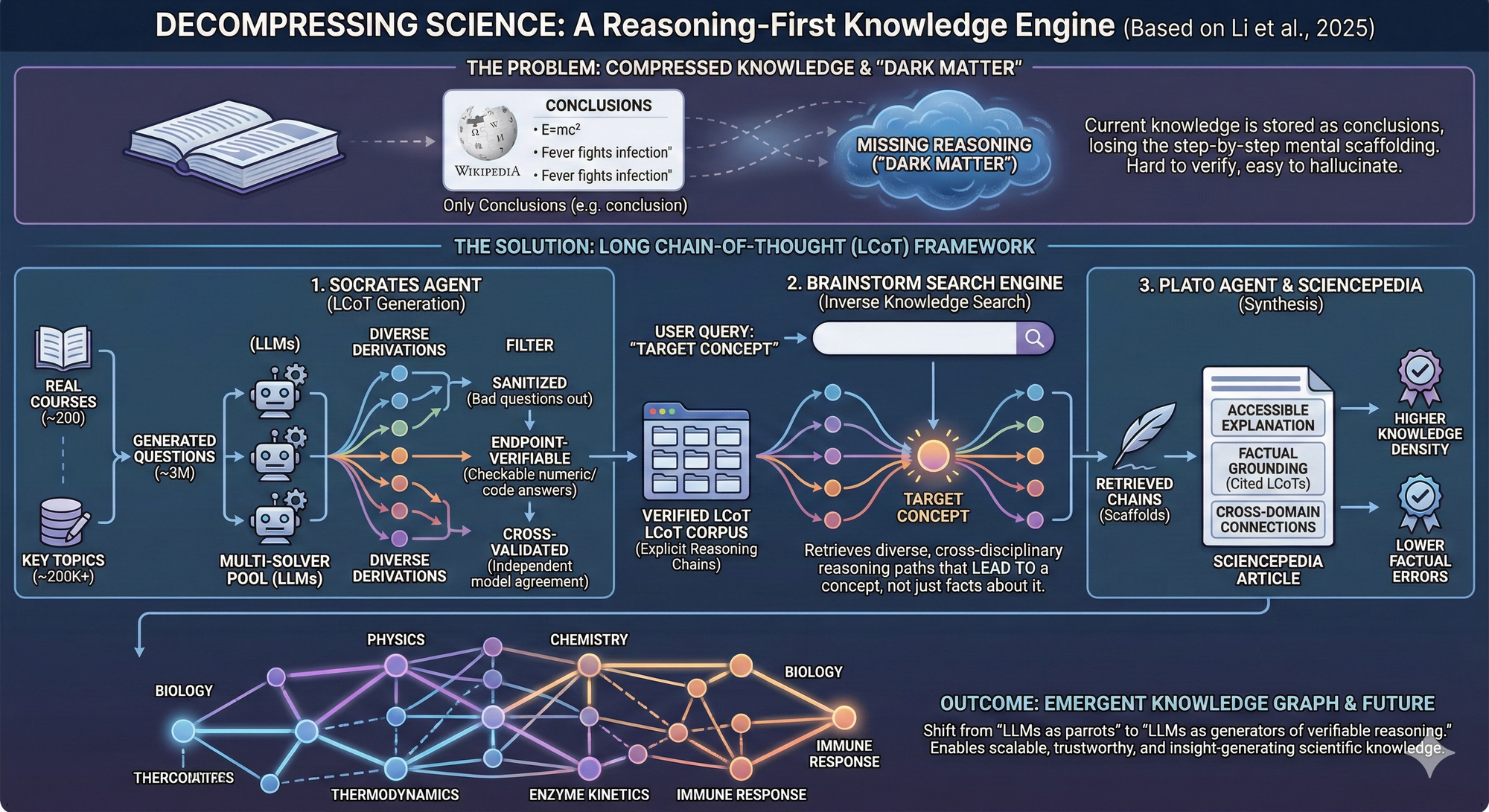
AI ‘Dark Matter’ - Using Verifiable Reasoning Chains and Inverse Search
Instead of using LLMs to regurgitate facts, what if we used them to reconstruct the reasoning behind the facts?
Instead of using LLMs to regurgitate facts, what if we used them to reconstruct the reasoning behind the facts?

the hard part moved from “how to do the work” to “what’s worth doing,” and “how to know if it worked

AI loves playing it safe with neutral, fence-sitting answers. But if you want real depth, push it to take a stance. Here's how to get AI to argue like a pro instead of droning on like a Wikipedia page.

Explore how ontologies are transforming AI decision-making. From enhancing reasoning and data interoperability to enabling real-time updates and multi-agent coordination, discover 10 ways ontologies are making AI smarter.

Reasoners “thinking” before responding, improving logic and problem-solving without larger models. They excel in structured tasks but struggle with creativity. A $30 experiment showed this approach could make AI smaller, cheaper, and more efficient, reshaping the future of AI development.

Streamline workflows and boost productivity with a personalized prompt library. Learn the steps to create, organize, and maximize prompts for tools like ChatGPT, Claude, and MidJourney.

Learn key techniques to optimize small-scale RAG systems for efficient, accurate data retrieval and enhanced performance.

This is THE definitive guide on using Temperature and Top-p with modern LLMs.

Explore the critical flaws in current AI language model benchmarks, the impact of overfitting, and emerging techniques like grokking that promise to improve generalization and reasoning capabilities in next-generation AI systems.


A look at zero-shot prompting, a technique that enables large language models to perform tasks without explicit training data. Explore its benefits, limitations, best practices, and real-world applications.

Here's a list of utility prompts that may not fit into a precise workflow.

Craft a robust Tone of Voice (TOV) guideline for consistent brand communication. This framework covers brand analysis, audience segmentation, tone attributes, and contextual adjustments. Ideal for marketers and brand managers seeking clarity and impact.

This Library contains a number of AI Prompts to Create Detailed reports on given content, including books, stories, articles, news and so on.

Functional Inference Synthesis, Functional LLMs, and Generative AI Networks (GAINs) are revolutionising application development and deployment, offering unprecedented efficiency and adaptability.

Complete Prompt Template Library

Develop a prompt library with broad templates refined into specific use case recipes. Ensure precision and utility through iterative refinement and specialized templates, with proper indexing for organization and traceability, demonstrated in medical report creation.

Query reformulation involves refining and clarifying user queries to enhance the accuracy and relevance of responses from AI systems like ChatGPT or Claude. This technique can improve user interactions, save time in technical domains, and optimize the performance.

Prompt Library - These are a collection of miniscripts and processors, designed for efficiency and productivity. You won't find a library like this anywhere else.

Prompt Library - These are a collection of AI Agents, designed for novelty, nuance and originality. You won't find a library like this anywhere else

Prompt Library - These are a collection of AI partials, designed for implementation, workflow and cognitive reasoning. You won't find a library like this anywhere else.

This article reveals a superior alternative to reverse prompt engineering for AI training. Discover a structure-driven methodology for analyzing output examples, defining AI roles, and crafting powerful prompts that unlock high-quality content generation.

Develop personalized and interactive digital doppelgangers with our comprehensive framework. Enhance customer service, executive communication, and consulting while ensuring security, privacy, and cultural sensitivity.

Discover a comprehensive framework for mastering prompt engineering, including detailed and simplified lifecycles for effective AI prompt management. Perfect for both large-scale applications and individual users.