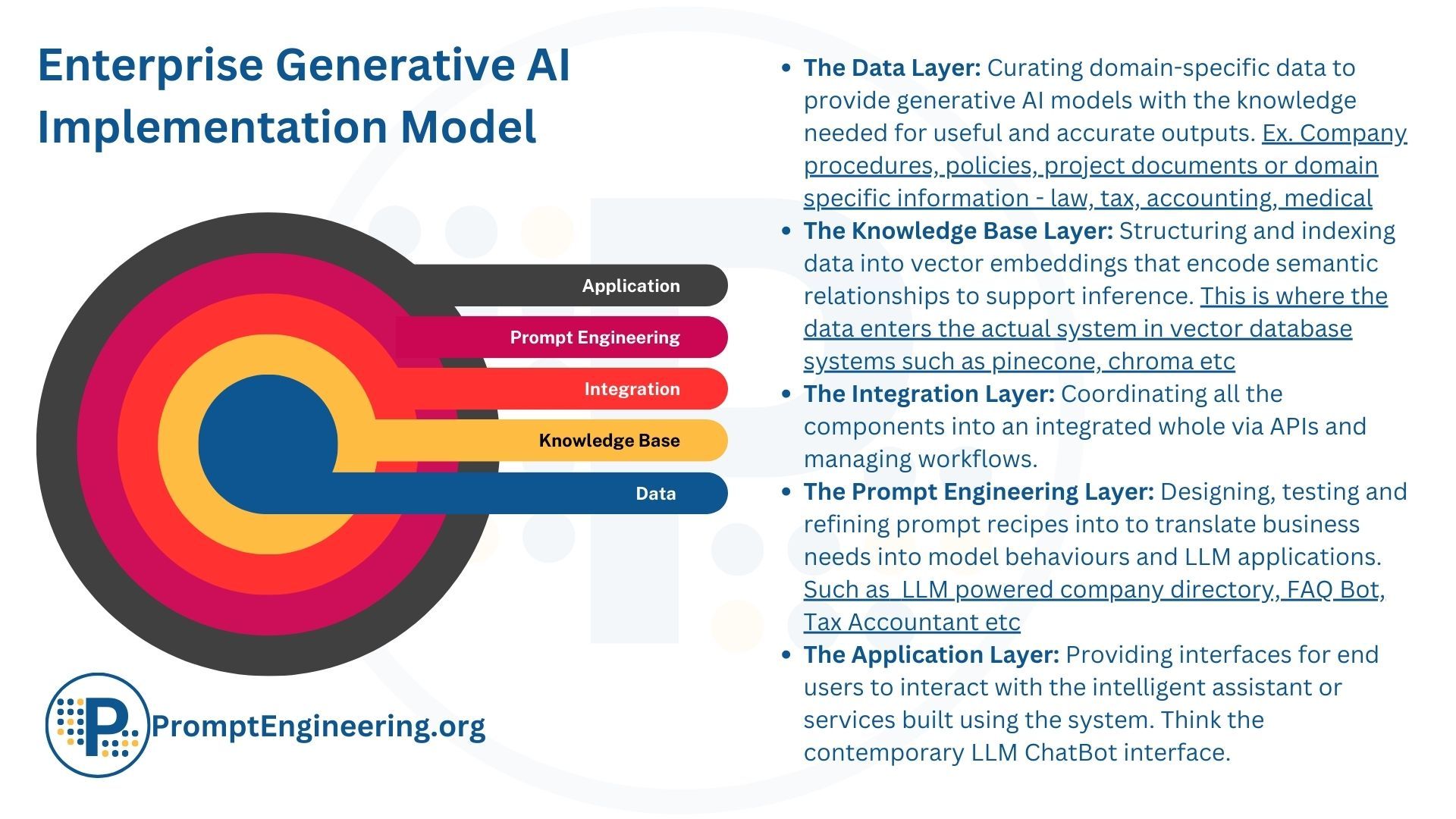
Discover the role of the prompt engineering layer in generative AI, optimizing interactions and workflows. See how Make.com and Zapier simplify integration, enabling scalable AI solutions with GPT-4 and Claude. Learn more at PromptEngineering.org.
The prompt engineering layer, sometimes referred to as the orchestration layer, is a critical component of the generative AI framework, focused on designing and optimizing the interactions between users and AI models. This layer ensures that AI systems generate accurate, relevant, and useful outputs tailored to specific business needs. Below is a detailed discussion of this layer, along with examples to illustrate its importance and functionality.
The prompt engineering layer involves more than just designing and optimizing individual prompts. It encompasses the broader task of converting business workflows and processes into comprehensive AI-driven scenarios, leveraging the integration layer to
Explore how AI, specifically language models like ChatGPT, is reshaping our work and creativity without replacing the unique qualities that make us human. Learn strategies for integrating AI ethically and effectively to enhance capabilities and maintain a human-centric approach.
Embracing AI: Enhancing Human Uniqueness and Adaptability
As humans, we often face a naturalresistance to change, especially when it involves integrating advanced technologies like Artificial Intelligence (AI) into our daily lives and workspaces. The idea that AI might not only write but think, stirs a deep-seated question: What then remains of our uniqueness? It's a valid concern, reflecting our ongoing struggle to understand and position ourselves in a world increasingly mediated by machines.
However, it's important to recognize that while language models such as ChatGPT excel at processing and applying the vast repository of human knowledge,
Explore our innovative framework that utilizes LLMs for educational storytelling, designed to simplify complex concepts for non-experts.
In our previous discussions, we explored the utilization of heuristics and Large Language Models (LLMs) to solve complex problems and develop AI-driven workflows tailored to specific use cases. Building on these insights, we introduce an innovative framework that harnesses the formidable capabilities of LLMs to demystify complex legal, health, and other intricate concepts. This framework leverages storytelling, a powerful pedagogical tool, to make these concepts accessible to non-experts, thereby enhancing literacy and fostering engagement, whether in professional teams or within civic contexts.
Storytelling, when powered by advanced LLMs, transforms abstract and dense information into engaging and relatable narratives.
Discover how the Emotional Intelligence (EI) Graph provides a structured approach to developing and regulating emotional intelligence skills. Learn about EI Clusters, Cognitive Chains, and Nodes, and how they work together to support personal growth and well-being.
Introduction to the EI Graph for LLMs
To create humanlike and empathetic interactions when dealing with conversational AI, language models, AI agents, and chatbots must recognize, understand, and respond to emotional cues. The Emotional Intelligence (EI) Graph for LLMs is a structured framework designed to address this need by representing the emotional prompting processes in a systematic and modular manner.
The Emotional Intelligence (EI) Graph for LLMs is a structured framework designed to enable large language models, AI agents, and chatbots to recognize, understand, and respond to emotional cues in user interactions. The EI Graph for LLMs is composed of several EI Clusters, each focusing on a specific aspect of emotional intelligence that is relevant and applicable to conversational AI.
Within each EI Cluster for LLMs, there are Cognitive Chains that provide a sequential and logical progression of steps to guide LLMs, AI agents, and chatbots in processing and responding to emotional cues. These Cognitive Chains are designed to break down the emotional understanding and response generation process into manageable and interconnected tasks.
The individual elements within each Cognitive Chain for LLMs are called Nodes. Nodes represent specific functions, algorithms, or prompt templates that LLMs, AI agents, and chatbots use to recognize, interpret, and generate emotionally appropriate responses. Each Node is carefully designed to handle a specific aspect of emotional processing, such as sentiment analysis, empathy generation, or emotional tone modulation.
By organizing the emotional prompting processes into this hierarchical structure of EI Graph for LLMs, EI Clusters for LLMs, Cognitive Chains for LLMs, and Nodes for LLMs, we create a systematic and modular approach to enabling emotionally intelligent interactions in conversational AI.
LLMs, AI agents, and chatbots like ChatGPT and Claude can utilize this structured approach to process user inputs, recognize emotional cues, and generate responses that are emotionally appropriate and empathetic. The EI Graph for LLMs serves as a guide for these AI systems to navigate the complexities of human emotions and provide more humanlike and emotionally intelligent conversations.
The development of the EI Graph for LLMs involves a collaborative effort between AI researchers, psychologists, and language experts to ensure that the emotional prompting processes are grounded in psychological theories of emotional intelligence while being adapted to the unique capabilities and constraints of language models and conversational AI.
Regular updates and refinements to the EI Graph for LLMs based on user feedback, advancements in emotional intelligence research, and improvements in language modelling techniques will ensure that the emotional prompting processes remain effective, relevant, and aligned with the evolving landscape of conversational AI.
Terminology:
Emotional Intelligence (EI) Graph for LLMs: A structured framework that represents the emotional prompting processes designed to enable LLMs, AI agents, and chatbots to recognize, understand, and respond to emotional cues in user interactions.
EI Clusters for LLMs: The main categories or domains of emotional intelligence capabilities within the EI Graph for LLMs. These clusters are based on specific aspects of emotional intelligence that are relevant and applicable to language models and conversational AI.
Cognitive Chains for LLMs: The sequential steps or processes within each EI Cluster that guide LLMs, AI agents, and chatbots in processing and responding to emotional cues in user interactions. Cognitive Chains provide a logical progression of tasks and prompts to enable emotionally intelligent responses.
Nodes for LLMs: The individual components or elements within a Cognitive Chain for LLMs. Nodes represent specific functions, algorithms, or prompt templates that LLMs, AI agents, and chatbots use to recognize, interpret, and generate emotionally appropriate responses.
Developing EI Graphs
Developing an effective structure process for creating EI Graphs is crucial to ensure that the emotional prompting processes are comprehensive, well-organized, and aligned with established emotional intelligence models. Here's a proposed structure process for developing EI Graphs:
💡
These steps can be greatly assisted by AI, however depending on the degree of reliance, purpose and the need for emotional sensitivity these should be tested, reviewed and measured against professional networks and models.
The OPUS Framework enables the creation of high-quality, relevant AI-generated content through a structured approach to crafting effective prompts from initial observations.
1. Introduction
1.1. The Importance of Prompt Engineering in AI and Machine Learning
As AI and LLM technologies continue to advance, the demand for more accurate, contextually relevant, and task-specific outputs has grown exponentially. Prompt engineering addresses this need by enabling developers to craft prompts that elicit high-quality, targeted responses from AI models. By carefully designing prompts that encapsulate the desired format, style, and content, prompt engineers can significantly enhance the performance of AI systems in various domains, such as natural language processing (NLP), conversational AI, and content generation.
Best practices for implementing AI in healthcare, drawing on lessons learned for a safe, effective, and patient-centered approach.
The rapid evolution of AI, particularly Generative AI, has unlocked exciting potential for transforming patient care. However, effective implementation takes more than just cutting-edge technology.
This framework draws upon lessons learned from the past two years of Generative AI integration within clinical and healthcare-related settings. It offers a roadmap for maximizing the benefits of AI while proactively addressing potential challenges. The core principles outlined here aim to ensure safe, patient-centric, and sustainable AI adoption across the healthcare landscape.
But first it's important for us take a walkthrough and discuss some of the key topics currently affecting
Reasoners “thinking” before responding, improving logic and problem-solving without larger models. They excel in structured tasks but struggle with creativity. A $30 experiment showed this approach could make AI smaller, cheaper, and more efficient, reshaping the future of AI development.
There’s been a lot of noise lately about AI replacing programmers.
Apps like Cursor, Windsurf, Loveable, Cline, Aider, Bolt, and others have sparked heated debates, often painted in stark black-and-white terms: either AI will replace programmers, or it won’t.
But that framing misses the point. The
Discover how carefully chosen prompt keywords enhance the effectiveness of language models. Learn how to craft precise prompts to improve the reliability and usefulness of AI responses.