Meet the AI doctor in your pocket. Dr. GPT leverages the vast medical knowledge of ChatGPT to provide free preliminary diagnoses anytime, anywhere.
Introducing Dr. GPT - Your AI Assistant Doctor
Dr. GPT was created as a spinoff from our previous article on how doctors and patients can use ChatGPT for smarter, more accessible healthcare. The enthusiastic response inspired us to release this AI agent focused solely on medical diagnosis.
Designed using advanced prompt engineering techniques, Dr. GPT aims to provide free preliminary diagnostic opinions to complement human doctors. This doctor assistant leverages GPT's vast and growing medical knowledge through guided prompting for logical analysis.
Dr. GPT represents our commitment to shaping AI technology for human benefit. We hope this virtual GP can make quality healthcare guidance more available to all while demonstrating prompt engineering's potential.
If you want to learn more about crafting prompts or our work in AI safety and ethics, please subscribe or contact us.
Together we can ensure technologies like Dr. GPT are leveraged as a force for good in medicine and beyond.
As language models like GPT-3 and GPT-4 demonstrated increasing medical knowledge and language proficiency, we wondered if conversational AI could be responsibly leveraged to provide preliminary health guidance.
By assigning the AI the role of Dr. GPT, a virtual general practitioner, we could prime it to synthesize its medical understanding into diagnostic opinions when systematically prompted. Dr. GPT combines GPT's vast knowledge with structured critical analysis using advanced prompt engineering.
The result is an AI assistant that reasons through symptoms like a doctor would, explaining its logic each step of the way. While just a starting point, Dr. GPT shows the potential for thoughtfully designed prompts to unlock AI's knowledge for human benefit. We're excited to continue refining Dr. GPT to be an even more reliable, transparent, and helpful diagnostic aid.
From robot doctors to disease-detecting algorithms, AI is bringing healthcare into the future by making it predictive, optimized, and inclusive.
The increased usage of generative AI and large language models (LLMs) has the potential to dramatically transform the healthcare industry in the coming years. Healthcare systems around the world are reaching their limitations, facing challenges like ageing populations, rising costs, staff shortages, and difficulties in providing inclusive care. AI offers innovative solutions to tackle these systemic issues in healthcare.
Enhancing Patient Care and Outcomes
A major application of AI in healthcare involves analyzing complex medical data to uncover insights that can improve patient diagnoses, treatment plans, and health outcomes. AI algorithms can detect patterns and correlations in patient data that
Behind the AI hype lies a quiet revolution in healthcare: robots taking over drudgery so clinicians can focus on patients.
Artificial intelligence (AI) holds incredible promise for transforming healthcare. While visions of AI replacing doctors get a lot of hype, the technology's greatest near-term impact is likely to come from automating clinical workflows. By taking over repetitive administrative and diagnostic tasks, AI could free up doctors and nurses to focus more on direct patient care.
The Burden of Clinical Documentation
A major pain point in healthcare today is the burden of clinical documentation. Doctors spend an exorbitant amount of time on EHR data entry, documentation, coding, and other clerical work. By one estimate, for every hour doctors spend
Can ChatGPT's vast medical knowledge combine with clinical-level logic? Through prompt engineering frameworks like CRISP, the future of AI health analysis is coming.
For anyone looking to take charge of their health journey, ChatGPT presents an exciting new option to aid in your own medical research and understanding.
For Patients: While no replacement for professional medical advice, this free (or very affordable) conversational AI system allows regular people to easily tap into an extensive knowledge base for preliminary health guidance whenever needed.
For Doctors: ChatGPT present exciting new opportunities for physicians to improve patient care and education. Doctors can leverage ChatGPT's medical knowledge to generate detailed diagnostic reports, treatment plans, and explanations of complex conditions in plain language for patients.
💡
This is a baseline framework you can use to tweak to your particular case i.e. Patient, doctor, advocate, etc.
With responsible use, ChatGPT can be an invaluable starting point for investigating health concerns, grasping terminology, asking questions, and determining if further professional help is required.
When utilized properly, it puts transparent, accessible health information and education directly into the hands of patients and caregivers.
However, to optimize ChatGPT for your health needs, there are a few best practices to keep in mind: Clearly explain symptoms, be detailed in your questions, request simplification of complex terms, fact-check all information against reliable sources, and always defer to a licensed healthcare provider for official diagnoses and treatment plans.
Utilizing the CRISP Prompt Engineering Framework
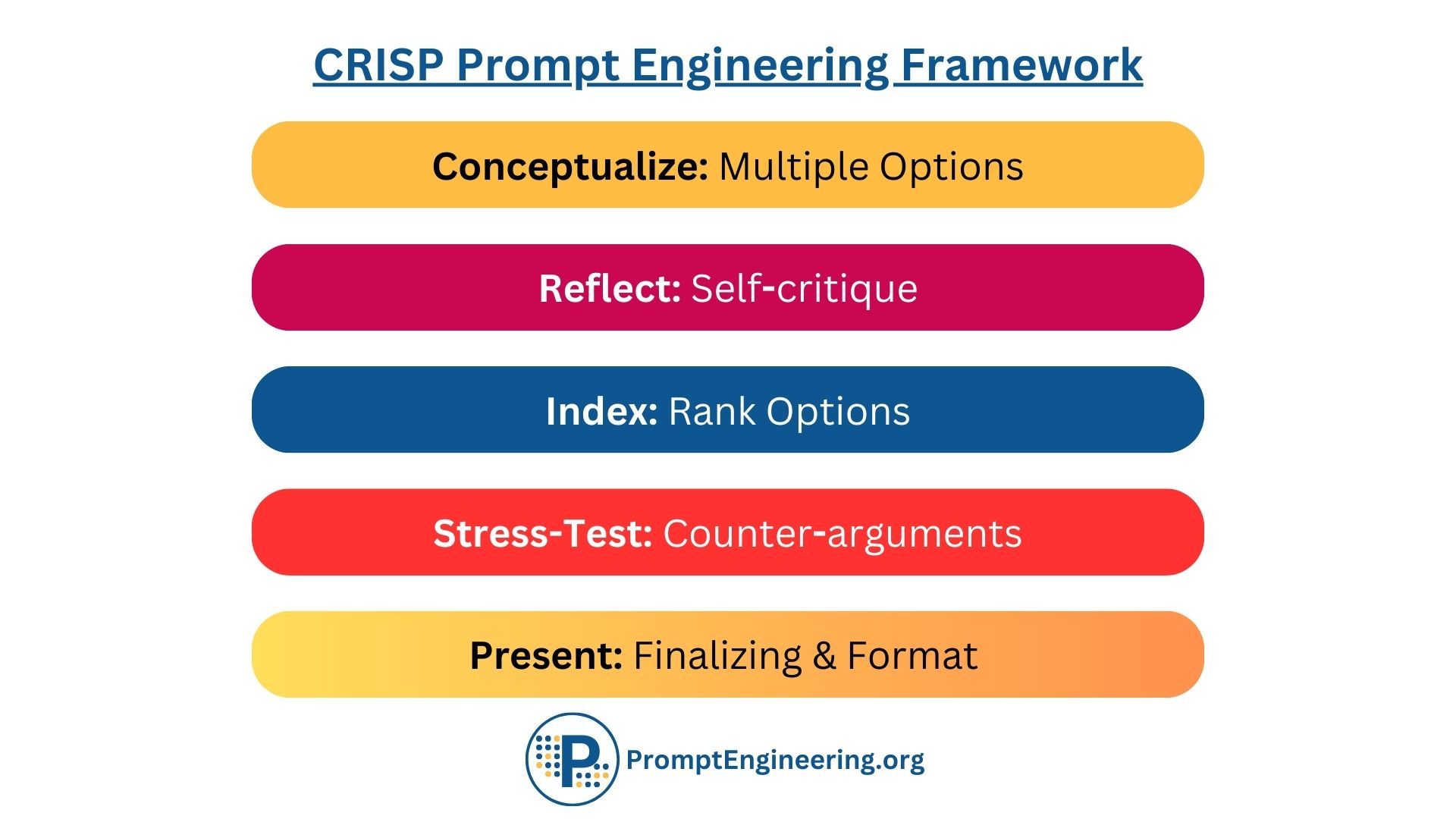
When querying ChatGPT on health topics, it is important to structure prompts to guide the AI towards critical thinking using frameworks like CRISP (Conceptualize, Reflect, Index, Stress-test, Present).
As a statistical model, ChatGPT lacks inherent reasoning capabilities despite its vast knowledge. CRISP compensates for this by scaffolding the AI through staged prompting focused on logic and reflection. This directs ChatGPT to synthesize information and critically evaluate responses beyond just regurgitating data.
Applying CRISP allows us to complement ChatGPT’s impressive knowledge base with more advanced reasoning. The result is output with greater logical soundness – combining expansive AI knowledge with structured critical analysis for assured confidence in the health guidance provided.
TheCRISP framework unlocks ChatGPT’s full potential.
In its early testing stages, ChatGPT has already demonstrated promising capabilities in medical knowledge and decision-making. Some notable achievements include:
The impressive exam performance and diagnostic capabilities demonstrated by ChatGPT have several important implications:
Passing medical licensing and life support exams shows this AI's potential to master complex medical information and protocols at a level required of human physicians. This could make ChatGPT a powerful training and education tool for clinicians. However, safeguards would be needed to prevent fully autonomous medical decision-making by AI.
Accurate rare disease diagnosis indicates ChatGPT may be able to enhance and expand medical differential diagnosis. The AI could surface possibilities outside a physician's expertise or experience. At the same time, human clinicians would still need to validate any AI-generated diagnoses.
Rapid improvements in ChatGPT's medical reasoning reinforce the speed at which AI abilities are scaling up. As models continue to train on vast data sets, their applicability in healthcare may grow quickly. Constant model updates and monitoring will be necessary to ensure recommendations remain current and aligned with evolving best practices.
Broader AI applications like improving efficiency, empathy, and research could fundamentally transform how care is delivered and discovered. However, integrating conversational AI into sensitive clinical workflows will require meticulous testing for patient safety and privacy protection.
Increasing diagnostic accuracy scores highlight ChatGPT's potential to complement human clinicians' skills and knowledge. Yet even high accuracy rates would not justify fully independent AI diagnosis without clinicians. Ongoing human supervision is critical to avoid potential misdiagnoses and harmful health outcomes.
While ChatGPT's progress is promising, each medical achievement warrants cautious optimism. Thoughtful governance and ethics are vital to harnessing conversational AI to improve medicine while avoiding the risks of misinformation, automation, and dehumanization of care.
Symptoms Diagnonsis ChatGPT Prompt Guide
To evaluate ChatGPT's diagnostic accuracy, we will provide details of a real but rare medical case that falls outside of GPT-4's training dataset. This allows us to genuinely test ChatGPT's analytical capabilities rather than its memory, as it will not have seen this specific case during training. By assessing performance on an uncommon scenario from actual clinical practice, we can better understand ChatGPT's strengths and limitations in logical reasoning versus recall.
Template Included
To make this diagnostic process more accessible, we've created a downloadable Excel template that allows you to neatly compile symptoms, test results, and background information on a patient. This structured input can then be easily copied and pasted into ChatGPT prompts for efficient diagnosis.
The template is particularly helpful for caregivers and loved ones assisting someone with a chronic or complex condition that requires regular consulting with ChatGPT.
Artificial intelligence (AI) has proven itself as a potentially game-changing tool to assist radiologists in detecting tumours earlier and more accurately, giving patients the best chance of survival.
Artificial intelligence (AI) is transforming various fields, and medicine is no exception. Recent research has explored the use of AI to aid in breast cancer screening and detection through the analysis of mammograms.
A new study published in The Lancet Oncology indicates that AI can boost breast cancer detection rates and reduce radiologists' workloads when used as a tool alongside human expertise.
This emerging technology demonstrates the immense potential to improve breast cancer outcomes through earlier detection. However, more research is still needed before AI becomes a standard part of clinical practice.
Amazon recently unveiled a HealthScribe: a new service that leverages generative AI to automate the cumbersome process of clinical documentation.
Healthcare continues to be one of the industries most impacted by generative AI. However, AI's influence has been going largely unnoticed in healthcare, at least until now. One of the giants of the tech and retail industry, Amazon, has been taking note and aims to leverage AI to transform clinical workflows.
Amazon recently announced AWS HealthScribe, a groundbreaking new service that leverages speech recognition and generative AI to automatically create preliminary clinical documentation from patient-clinician conversations. Its purpose is to streamline the burdensome process of clinical documentation. But AWS HealthScribe also has the potential to completely reshape the
Reasoners “thinking” before responding, improving logic and problem-solving without larger models. They excel in structured tasks but struggle with creativity. A $30 experiment showed this approach could make AI smaller, cheaper, and more efficient, reshaping the future of AI development.
There’s been a lot of noise lately about AI replacing programmers.
Apps like Cursor, Windsurf, Loveable, Cline, Aider, Bolt, and others have sparked heated debates, often painted in stark black-and-white terms: either AI will replace programmers, or it won’t.
But that framing misses the point. The
Discover how carefully chosen prompt keywords enhance the effectiveness of language models. Learn how to craft precise prompts to improve the reliability and usefulness of AI responses.


 Sunil Ramlochan - Enterprise AI Specialist
 Prompt-Engineering-org