Skip to Content

Implementation

7 posts

Posts tagged with Implementation

Stop Letting Automations Trip Over Themselves: The ACE Framework For Durable AI Workflows

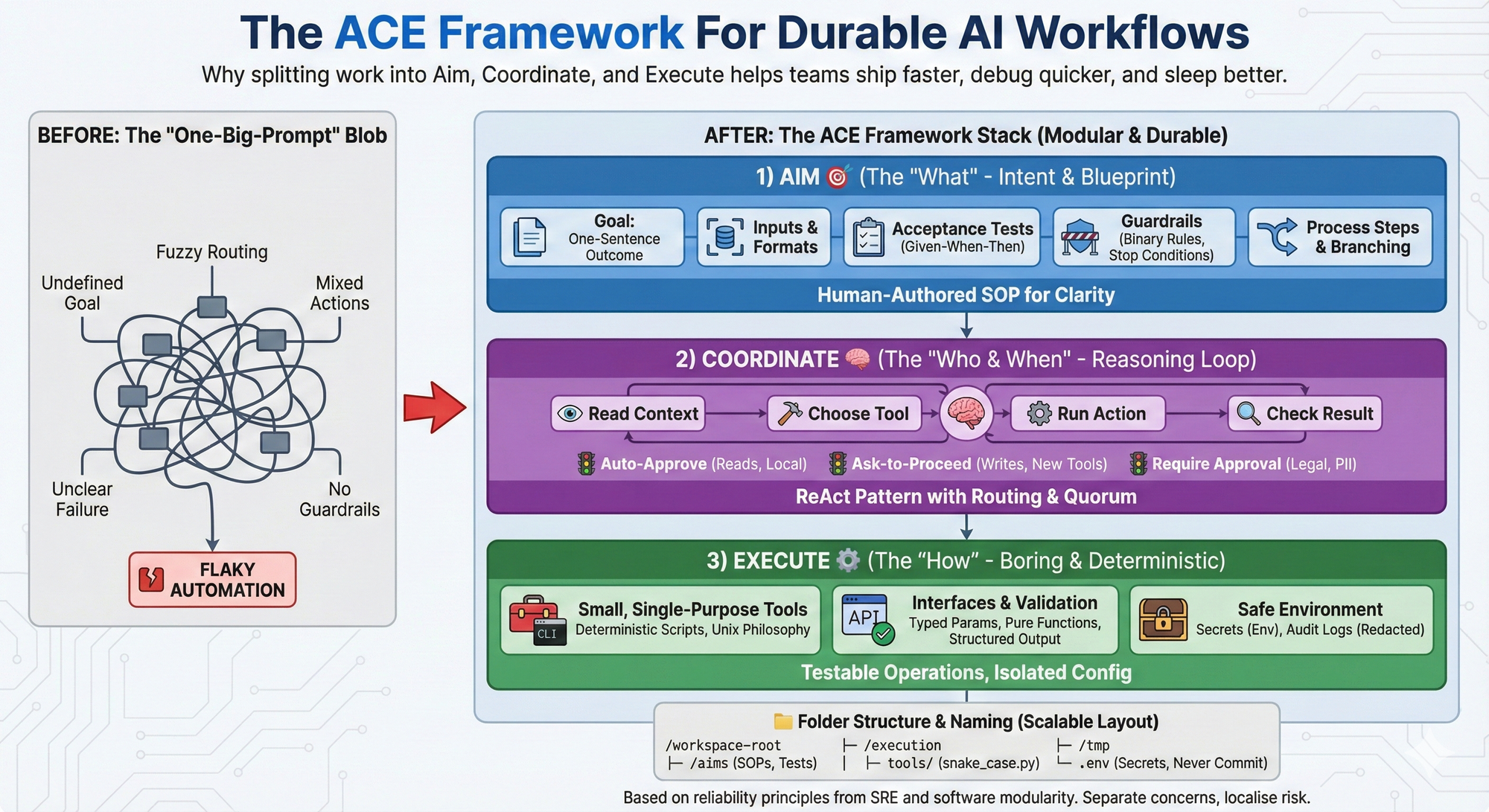
A practical guide to the ACE framework for automation reliability. Learn how to split work into Aim, Coordinate, and Execute so you can move faster, cut MTTR, and keep audits and on-call simple.

Why ACE beats one-big-prompt automations

Complex automations often fail because one blob tries to do everything. The ACE framework separates responsibility into three layers so each piece can be designed, tested, and improved on its own:

  1. Aim defines the business intent in plain language.
  2. Coordinate decides who or what runs next and when.
  3. Execute performs the work via deterministic scripts and tools.

This separation echoes classic software guidance on modular design. If you have never read David Parnas on modularization, his landmark paper explains why clear interfaces and information hiding make systems easier to reason about and test, which is
Stop Letting Automations Trip Over Themselves: The ACE Framework For Durable AI Workflows Read more

Agents At Work: The 2026 Playbook for Building Reliable Agentic Workflows

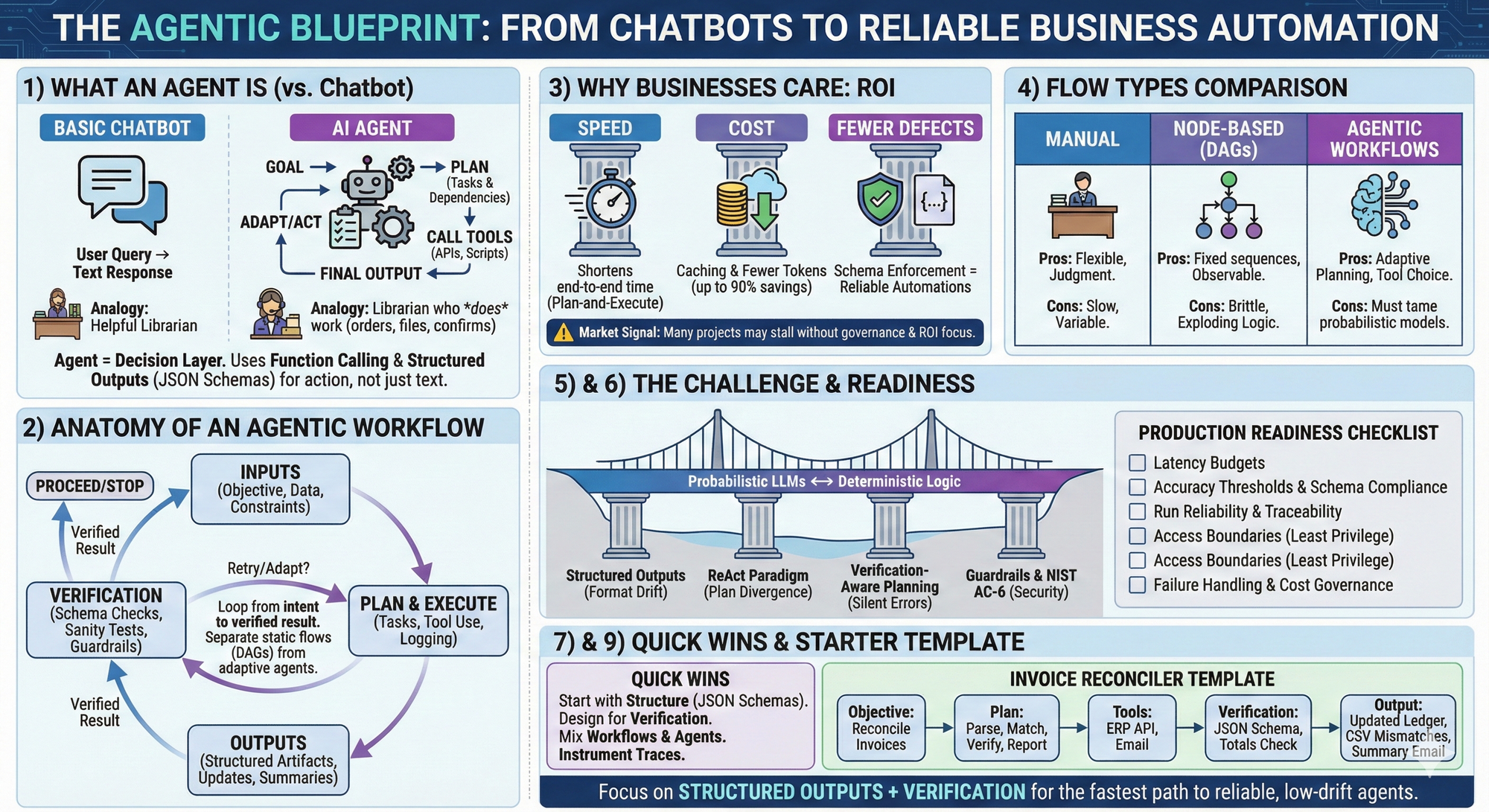
A practical guide to agentic workflows: what agents really are, how to design them for speed and reliability, where they beat static automations, and how to make them production ready with structured outputs, guardrails, and verification.

1) What an agent is, and what it is not

Plain definition. An agent is a decision layer that takes a goal, makes a plan, calls tools or APIs, and adapts based on the results it inspects. That is different from a basic chatbot that only returns text. Modern platform docs show the mechanics behind this: OpenAI’s tool and function calling explains how models select tools and use results in the next step, and Structured Outputs shows how to enforce exact JSON schemas so downstream systems get clean data. These are the building blocks of agent behavior.

Not magic.

Agents At Work: The 2026 Playbook for Building Reliable Agentic Workflows Read more

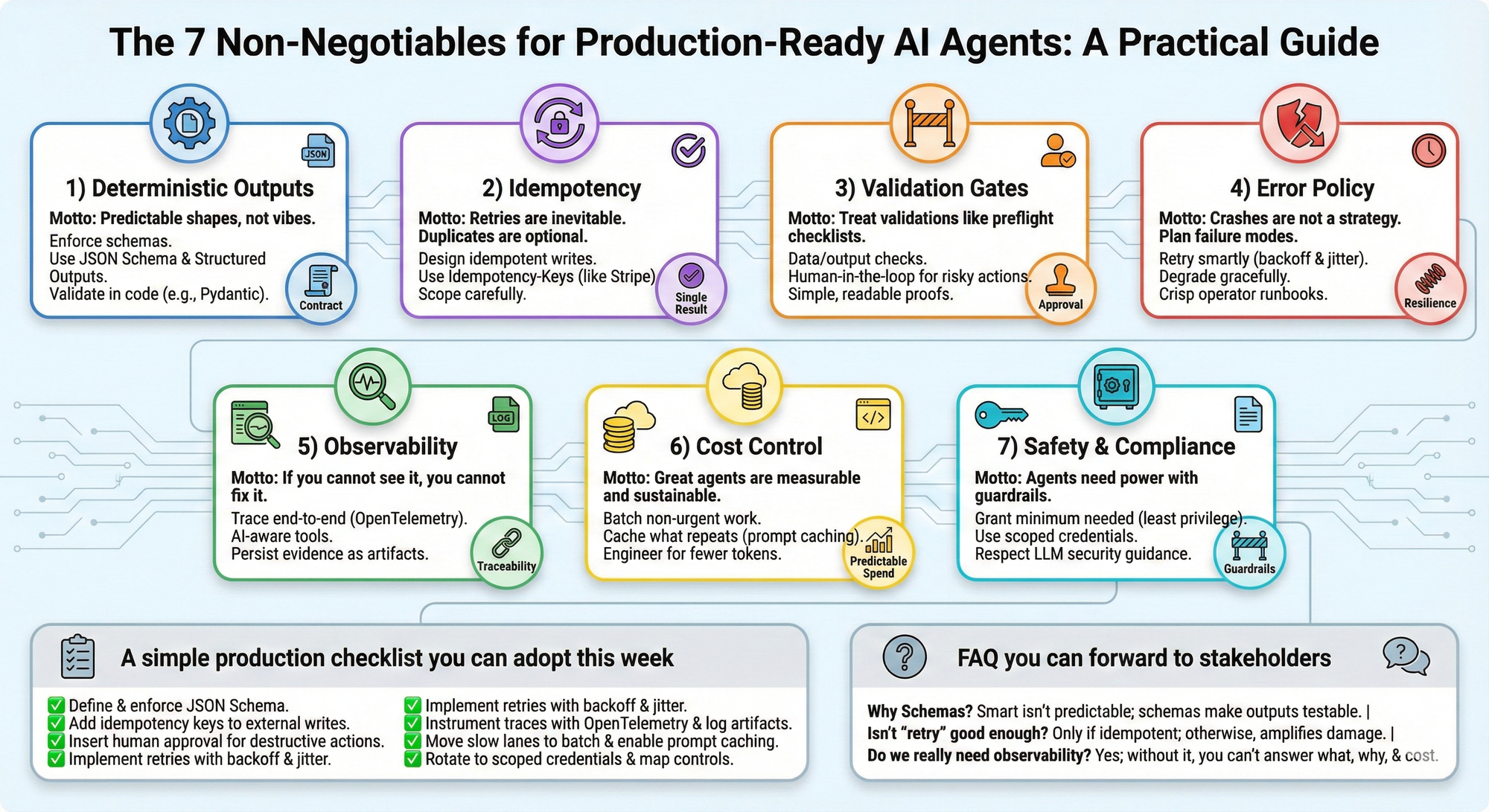
From hype to revenue: 7 non-negotiables for a production-grade agentic workflow

Modern AI agents can demo beautifully and disappoint in production. If you want real customers and real revenue, your workflow needs real engineering. Here's seven non-negotiables we see in teams that ship agentic systems with confidence, plus concrete practices and links to credible guidance.

7 non-negotiables for a production-grade agentic workflow

1) Deterministic outputs: schemas, stable files, explicit acceptance criteria

Customers and downstream systems need predictable shapes, not vibes.

  • Enforce a schema at the boundary. JSON Schema is the industry standard for describing and validating structure. It defines both a Core and a Validation spec so machines and humans agree on what is acceptable. See the official JSON Schema specification for details, including the widely adopted 2020-12 draft that most tooling targets. This is the reference you can hand to auditors and integrators alike, not a blog post. Read the JSON Schema spec and
From hype to revenue: 7 non-negotiables for a production-grade agentic workflow Read more

Client Zero to Industry Hero - Inside IBM’s Playbook for Automating HR and Scaling “Digital Workers”

How IBM automated 94% of transactional HR, cut HR spend by 40%, and removed $3.5B in cost, then turned internal experts into revenue. A step-by-step playbook you can adapt.

Introduction

Recently, I came across one of the most insightful podcasts on AI implementation that I’ve heard in a long time, a conversation with IBM’s ex-CEO and current head of consulting, Mohamad Ali. The discussion was a rare peek behind the curtain at how IBM, one of the world’s most iconic tech giants, has approached the daunting challenge of large-scale AI adoption.

What stood out wasn’t just the technology or the numbers, it was the clarity and practicality of their approach. Hearing directly from a leader who helped steer IBM’s transformation made me realize just

Client Zero to Industry Hero - Inside IBM’s Playbook for Automating HR and Scaling “Digital Workers” Read more

CFOs Embrace GenAI's Potential Amid Adoption Challenges - Deloitte Report

The 1Q24 Deloitte CFO Signals survey reveals CFOs' optimism and expectations for GenAI productivity gains, tempered by concerns over talent, skills, and measuring value.

CFOs Embrace GenAI's Potential Amid Adoption Challenges - Deloitte Report

Overview of the Deloitte CFO Report

Amidst a backdrop of economic and geopolitical uncertainty, the 1Q24 Deloitte CFO Signals survey reveals an upward shift in CFOs' outlook. Fifty-four percent of CFOs expect better economic conditions in North America in the next year, up from 37% in 4Q23. CFOs also raised their 12-month outlook for Europe, China, and Asia. Net optimism for their own companies' financial prospects jumped to +31 from +11 in the previous quarter.

However, concerns persist. Geopolitics, macroeconomics, the political environment, and interest rates rank as top external risks. Internally, talent availability, execution, cost management, innovation, and technology

CFOs Embrace GenAI's Potential Amid Adoption Challenges - Deloitte Report Read more

An Executive Overview to Strategic Generative AI Adoption

A simplified overview of key components for implementing enterprise-grade generative AI, including data curation, knowledge indexing and prompt engineering for customizable, scalable AI solutions.

An Executive Overview to Strategic Generative AI Adoption

Practical AI Implementation Strategies

With recent advancements in artificial intelligence (AI), specifically large language models (LLMs) like GPT-3, organizations now have access to powerful tools that can transform workflows. However, simply deploying these models is not enough to achieve meaningful results. Strategic implementation is crucial for unlocking the true value of LLMs. In this article, we explore practical strategies for leveraging LLMs to drive organizational success.

Identifying High-Impact Use Cases

Rather than viewing LLMs as a cure-all, organizations should identify specific use cases where these models can offer significant value. Four particularly compelling applications include:

  1. Documentation Tools: LLMs redefine documentation,
An Executive Overview to Strategic Generative AI Adoption Read more