Skip to Content

Lesson

51 posts

Posts tagged with Lesson

Improving Large Language Models with Retrieval Augmented Generation Featured Post

Redefining AI Conversations: How Retrieval Augmented Generation is supercharging Large Language Models for a smarter future.

Improving Large Language Models with Retrieval Augmented Generation

The Generative AI Revolution: An Introduction to Retrieval Augmented Generation

The release of ChatGPT in November 2022 sparked tremendous excitement about the potential for large language models (LLMs) like it to revolutionize how people and organizations use AI. However, in their default form, these models have limitations around working with custom data.

This is where the idea of retrieval augmented generation (RAG) comes in. RAG is a straightforward technique that enables LLMs to dynamically incorporate external context from databases. By retrieving and appending relevant data to prompts, RAG allows LLMs to produce high-quality outputs personalized to users' needs.

Since ChatGPT

Improving Large Language Models with Retrieval Augmented Generation Read more

A Strategic Framework for Enterprise Adoption of Generative AI Featured Post

Empower your organization or business with AI through this comprehensive framework and blueprint.

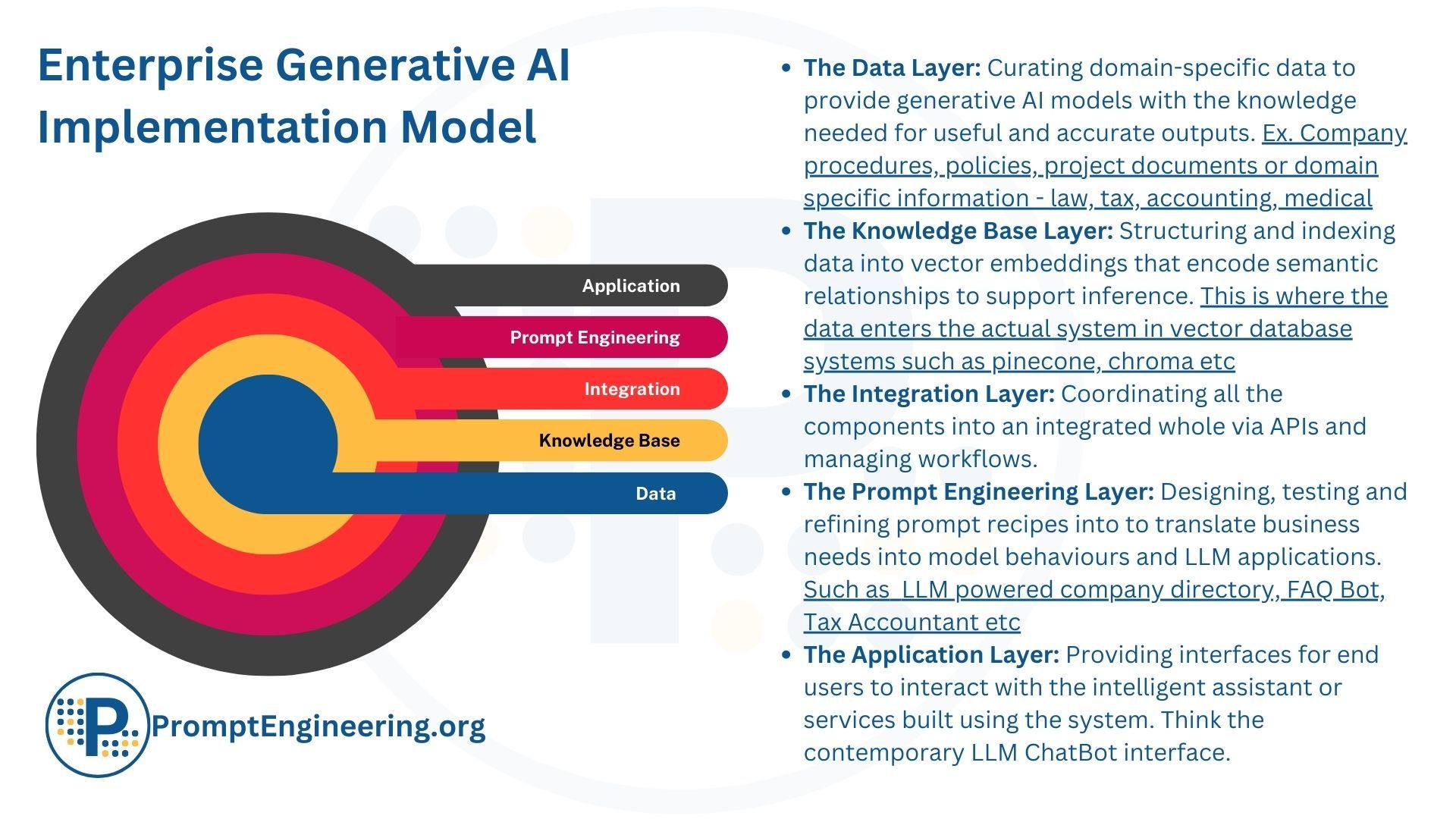
A Strategic Framework for Enterprise Adoption of Generative AI

TLDR:

This article outlines a layered model for strategically adopting generative AI within enterprises. The core components include:

  • Data layer - Curating high-quality, domain-specific datasets to provide the knowledge base for generative models.
  • Knowledge base layer - Structuring and indexing data for efficient querying by models during inference.
  • Integration layer - Unifying diverse services into a cohesive, modular AI platform.
  • Prompt engineering layer - Creating and optimizing interactions between humans and AI models.
  • Application layer – Providing interfaces for end users to interact with the intelligent assistant or services.

Together these layers enable businesses to leverage generative AI as a flexible

A Strategic Framework for Enterprise Adoption of Generative AI Read more

Statistical or Sentient? Understanding the LLM Mind - Part 1 - Memory Featured Post

Memory makes us human. Yet modern language AIs like GPT Models exhibit remarkable fluency without any human-like memory. How do they generate coherent text without the episodic memory fundamental to our own cognition? This article illuminates the inner workings and memory limitations of LLMs.

Statistical or Sentient? Understanding the LLM Mind - Part 1 - Memory

Demystifying the Mind of Large Language Models

The release of systems like ChatGPT in 2022 sparked sensational headlines about the dawn of artificial general intelligence (AGI) and fears that AI may soon become sentient or reach "God mode." Terms like "technological singularity" proliferate in both media coverage and developers' descriptions of large language models (LLMs).

However, this anthropomorphizing of LLMs fuels misconceptions. In this series, I will demystify the inner workings of systems like GPT-3/4/ChatGPT to expose their current limitations compared to human cognition.

Like Smeagol from Lord of the Rings, some AI researchers cherish their creations beyond

Statistical or Sentient? Understanding the LLM Mind - Part 1 - Memory Read more

What Are Large Language Model (LLM) Agents and Autonomous Agents Featured Post

Large language models are rapidly transcending their origins as text generators, evolving into autonomous, goal-driven agents with remarkable reasoning capacities. Welcome to the new frontier of LLM agents.

What Are Large Language Model (LLM) Agents and Autonomous Agents

Large language models (LLMs) like GPT-4 have demonstrated impressive capabilities in generating human-like text. Recent explorations go beyond text generation, framing LLMs as the core controller of agents and autonomous agents that can not just write but also reason, act, and learn.

LLMs have the potential to function as artificial general intelligence systems. They are rapidly transforming from passive language systems into active, goal-oriented agents capable of autonomous reasoning and task completion.

This development marks a seismic shift in artificial intelligence and promises to revolutionize how humans interact with machines.

What is a Large Language Model (LLM) Agent

An LLM

What Are Large Language Model (LLM) Agents and Autonomous Agents Read more

Generative AI Networks (GAINs) Featured Post

GAIN is a Prompt Engineering technique to solve complex challenges beyond the capabilities of single agents.

Generative AI Networks (GAINs)

Introduction to Generative AI Networks (GAINs)

Generative AI Networks, or GAINs, is a shift in the field of artificial intelligence. Unlike traditional AI models that operate as single, isolated entities, GAINs harness the power of multiple AI agents working in concert. This multi-agent approach enables tackling complex challenges that are beyond the scope of individual AI systems.

Concept and Evolution of GAIN

  • Origin and Development: The concept of GAIN, developed by the Prompt Engineering Institute, emerged from our need to enhance the capabilities of AI systems. Initially, AI focused on single-agent models, where each AI operated independently, often limited to
Generative AI Networks (GAINs) Read more