Skip to Content

LLM

73 posts

Posts tagged with LLM

Democratizing AI: How GPT4All is Pioneering Community-Powered Local LLMs

Artificial intelligence is undergoing a revolution - one that is decentralized, transparent, and community-driven. At the forefront lies GPT4All, an ambitious open-source project democratizing access to cutting-edge large language models.

Democratizing AI: How GPT4All is Pioneering Community-Powered Local LLMs

TLDR;

  • GPT4All is an open ecosystem created by Nomic AI to train and deploy powerful large language models locally on consumer CPUs.
  • The goal is to create the best instruction-tuned assistant models that anyone can freely use, distribute and build on.
  • GPT4All models are 3GB - 8GB files that can be downloaded and used with the GPT4All open-source software. Nomic AI maintains this software and helps users train customized models.
  • High-quality training and instruction-tuning datasets are needed to create powerful assistant models. Nomic AI's Atlas platform helps curate and manipulate data.
  • The latest open-source GPT4All dataset is available on HuggingFace,
Democratizing AI: How GPT4All is Pioneering Community-Powered Local LLMs Read more

Benchmarking AI Brilliance with Arthur Bench

Ever wondered how to measure the brainpower of AI? Dive into the world of Arthur Bench and discover the tool reshaping the landscape of large language model evaluations.

Benchmarking AI Brilliance with Arthur Bench

Arthur, a New York City-based AI startup, introduces "Arthur Bench"—an innovative open-source tool aimed at evaluating and comparing the efficacy of LLMs. This tool not only demystifies the differences between various LLM providers but also presents a unique opportunity for businesses to tailor the tool's criteria to their specific needs, thus reinforcing the significance of transparency and customization in AI-driven solutions.

Understanding Arthur Bench

Purpose and Objective

As Adam Wenchel, the CEO and co-founder of Arthur, articulates, the intention behind Arthur Bench is to equip teams with a comprehensive understanding of the disparities between different LLM providers, the

Benchmarking AI Brilliance with Arthur Bench Read more

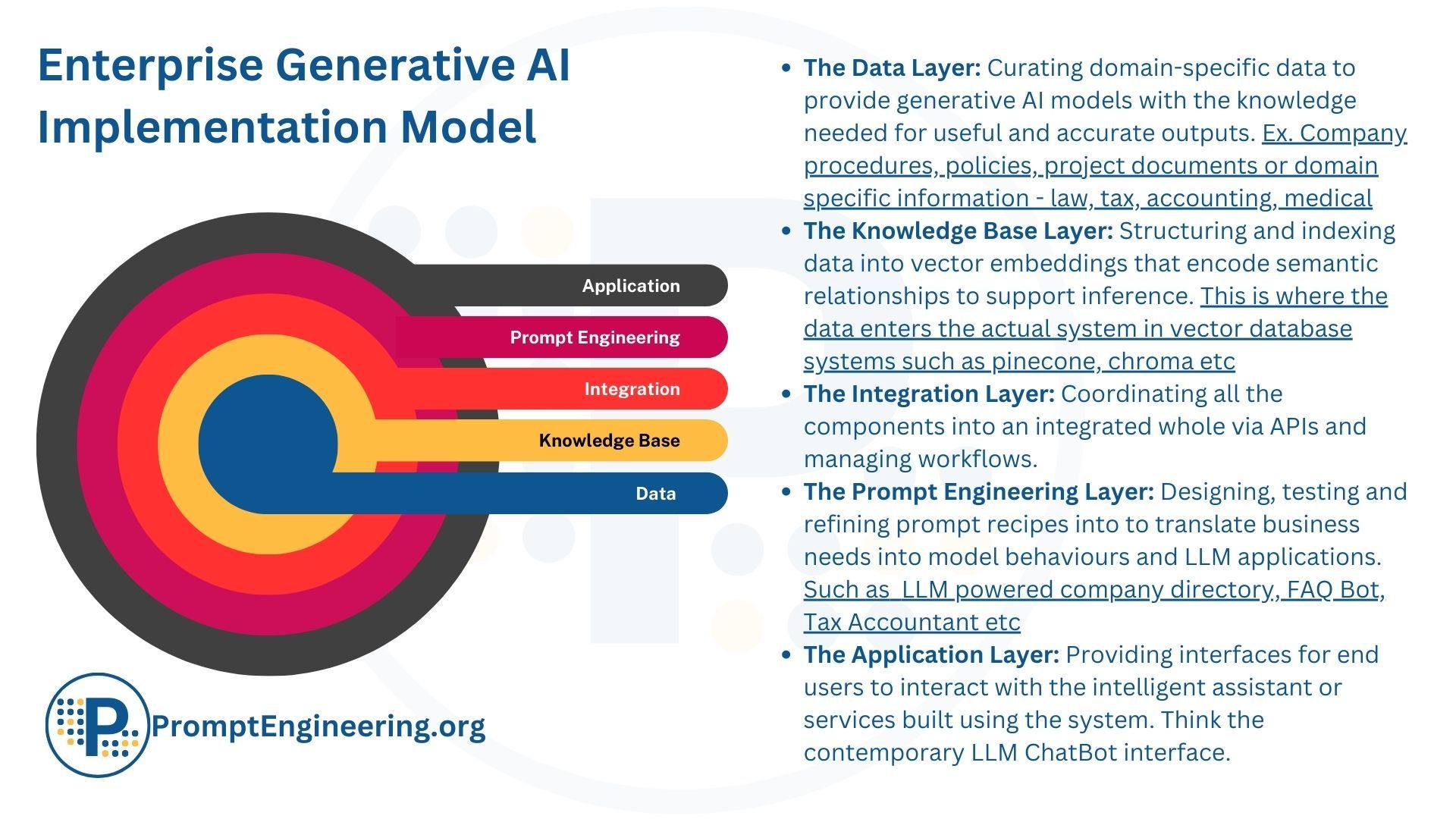
A Strategic Framework for Enterprise Adoption of Generative AI Featured Post

Empower your organization or business with AI through this comprehensive framework and blueprint.

A Strategic Framework for Enterprise Adoption of Generative AI

TLDR:

This article outlines a layered model for strategically adopting generative AI within enterprises. The core components include:

  • Data layer - Curating high-quality, domain-specific datasets to provide the knowledge base for generative models.
  • Knowledge base layer - Structuring and indexing data for efficient querying by models during inference.
  • Integration layer - Unifying diverse services into a cohesive, modular AI platform.
  • Prompt engineering layer - Creating and optimizing interactions between humans and AI models.
  • Application layer – Providing interfaces for end users to interact with the intelligent assistant or services.

Together these layers enable businesses to leverage generative AI as a flexible

A Strategic Framework for Enterprise Adoption of Generative AI Read more

Statistical or Sentient? Understanding the LLM Mind - Part 1 - Memory Featured Post

Memory makes us human. Yet modern language AIs like GPT Models exhibit remarkable fluency without any human-like memory. How do they generate coherent text without the episodic memory fundamental to our own cognition? This article illuminates the inner workings and memory limitations of LLMs.

Statistical or Sentient? Understanding the LLM Mind - Part 1 - Memory

Demystifying the Mind of Large Language Models

The release of systems like ChatGPT in 2022 sparked sensational headlines about the dawn of artificial general intelligence (AGI) and fears that AI may soon become sentient or reach "God mode." Terms like "technological singularity" proliferate in both media coverage and developers' descriptions of large language models (LLMs).

However, this anthropomorphizing of LLMs fuels misconceptions. In this series, I will demystify the inner workings of systems like GPT-3/4/ChatGPT to expose their current limitations compared to human cognition.

Like Smeagol from Lord of the Rings, some AI researchers cherish their creations beyond

Statistical or Sentient? Understanding the LLM Mind - Part 1 - Memory Read more

Taming the Beast: How Retrieval Augmentation Can Bolster Large Language Models

Large language models like GPT-3 showcase remarkable fluency but also inaccuracy and toxicity. To temper their limitations, researchers are augmenting models with true external knowledge - a gift no training data alone provides.

Taming the Beast: How Retrieval Augmentation Can Bolster Large Language Models

Retrieval Augmented Generation (RAG) is revolutionizing chatbot technology by enhancing Large Language Models (LLMs) to retrieve and process specific document-based information efficiently, paving the way for cost-effective and precise interactions.


The Emergence of RAG in Chatbots

Understanding the Core Principle of RAG

Retrieval Augmented Generation is an innovative approach that optimizes how LLMs access and utilize vast amounts of data. Instead of relying on embedding entire documents into a prompt for understanding, RAG smartly retrieves only relevant portions of text. This targeted retrieval method not only conserves resources but also ensures that interactions remain economically feasible.

How Retrieval Augmentation Models

Taming the Beast: How Retrieval Augmentation Can Bolster Large Language Models Read more

What Are Large Language Model (LLM) Agents and Autonomous Agents Featured Post

Large language models are rapidly transcending their origins as text generators, evolving into autonomous, goal-driven agents with remarkable reasoning capacities. Welcome to the new frontier of LLM agents.

What Are Large Language Model (LLM) Agents and Autonomous Agents

Large language models (LLMs) like GPT-4 have demonstrated impressive capabilities in generating human-like text. Recent explorations go beyond text generation, framing LLMs as the core controller of agents and autonomous agents that can not just write but also reason, act, and learn.

LLMs have the potential to function as artificial general intelligence systems. They are rapidly transforming from passive language systems into active, goal-oriented agents capable of autonomous reasoning and task completion.

This development marks a seismic shift in artificial intelligence and promises to revolutionize how humans interact with machines.

What is a Large Language Model (LLM) Agent

An LLM

What Are Large Language Model (LLM) Agents and Autonomous Agents Read more